● Freshman Year, June – Ayase Saki
A month has passed since I began my internship at Ruka-san’s design office.
Every day followed a familiar rhythm: arrive at the office, open my laptop, and dive into my tasks. In the moments between, I would ask my seniors to teach me the fundamentals of design or request reference materials. It was all self-study, but little by little, I was starting to learn. Juggling this with my university lectures kept me more than a little busy.
Or at least, that’s what I’d like to claim…
No, I am busy. I am. It feels tough, and it certainly should be. But whenever I witness the absurd workload my boss, Ruka-san, shoulders, I find myself hesitating to complain. As the one managing her schedule, I feel this reality more acutely than anyone. She juggles so many projects—units of work, as they’re called—that I often wonder how many clones of herself she’d need to get it all done.
Since the office is small, the individual projects are often modest in scale, and much of the actual work is handled by other employees. However, as the president, Ruka-san is responsible for compiling and assigning every project. She bears the final responsibility, which means she must constantly monitor the progress and quality of everyone’s work.
It’s a colossal amount of work… and as if that weren’t enough, she’s currently handling one particularly massive project.
The “Roppongi Art Festa.”
While the concept itself is a fresh endeavor, Roppongi has hosted large-scale art events for years. Ruka-san can’t tarnish the positive image the district has cultivated over time, yet she must also embrace new challenges to ensure attendees aren’t met with a mediocre experience. That balancing act becomes exponentially more difficult with the scale of the event. New things require energy, and there’s always a tendency to become conservative. That’s why the overall concept design is so crucial; it’s all about showcasing what makes this event different—or so Ruka-san explained.
So, what exactly was the concept, the aim, for the “Roppongi Art Festa”?
“A World of Art that Blends into Everyday Life.”
That was it. To be honest, I had no idea what it meant. After digging through the workspace logs on my computer, I’ll try to explain it in my own words.
It seems this exhibition aims to present “art that isn’t treated as something special.”
When we want to engage with art, what do we typically do? We go to a museum, a concert hall, or a theater. We journey to a special place for a special experience. That has its own merit, of course. Immersing yourself deeply in art is easier when you’re in a dedicated space, free from distractions. Going to such places helps you forget the trivialities of daily life. If I were going on a date with Yuuta, I’d choose a place like that, too. It makes the time together feel special.
But that very nature creates a high hurdle for “art.”
We want people to engage with art more casually. We want to lower the hurdles and give more people the chance to encounter artistic things. Many artists feel this way. Very well, then let’s provide a place where art can be expressed without pretense.
I’m not sure if that was the exact thought process, but it seems the event’s policy was established from that sentiment: to display various forms of art in a way that lets them blend naturally into the scenery of Roppongi. The idea was to hold an exhibition where art is placed within the everyday landscape, free of any sense of incongruity. A person passing by might happen to notice a piece, feel a touch of art, and be pleasantly taken aback. It’s an interesting concept, and I’ve learned recently just how fun surprises can be.
Ruka-san has been involved with this project since its inception. The core concept was finalized in May, before I joined the office. Meetings with the administrators of the display locations—The National Art Center, Tokyo; Tokyo Midtown; Mori Building; and the Roppongi Shopping Street Promotion Association—were also completed last month, along with the coordination for street-level spaces and parks.
In other words, the general guidelines of what will be done and how it will be done have already been decided. Now, they’re nailing down the specifics—negotiating with participating artists, checking their progress, and so on. Among the artists are, surprisingly, some from overseas. The genres are just as diverse, including painters, illustrators, and sculptors. I was excited by the thought of seeing works from up-and-coming young artists, especially those from overseas whose art isn’t easily accessible in Japan.
Inviting the artists, arranging their visas and accommodations also fell to Ruka-san. Consequently, in my secretarial role, I found myself reading and writing English emails to coordinate with them.
“I was relieved your emails were more solid than I expected,” Ruka-san had told me. “As expected of a Tsukinomiya girl.”
Hearing that, I let out a sigh of relief, grateful that my proactive English studies had paid off. But she immediately added a caveat.
“Ah, but don’t forget that you’re working as my secretary because you can’t do design work yet. This isn’t your main job. Writing English emails and managing schedules will be useful skills, but unless you plan on becoming a professional secretary, you mustn’t forget to learn design during your internship, okay?”
“Yes. Understood,” I replied, nodding earnestly at her words.
The reason I was drawn to Ruka-san’s work in the first place was a poster she designed for Melissa’s concert. The scale of her work wasn’t what interested me; that was never important. If I were the type to measure people by the size of their work, I could never respect my mother. After all, what’s wrong with being a bartender at a small bar?
But I digress.
For learning design, the “Roppongi Art Festa” was, just as Ruka-san said, unsuitable for a beginner. The scale was simply too large. As a result, most of Ruka-san’s work was dedicated not to the practical task of realizing a design concept, but to managing the people involved. The role of those at the top often becomes that way. It’s a tough job, I understand, but it’s not helpful for a novice trying to learn design.
For that reason, I’ve learned the most from the practical, day-to-day work handled by the other employees.
For instance, there’s Higashide Yume-san, who sits at the desk in front of mine. Everyone calls her “Yume-chan.” She’s a petite, friendly woman who always seems to be smiling, and I believe she’s about six years older than me.
Today, as always, she was up to something…
When the petite Higashide-san leans over her desk to work, it gives off the vibe of a small animal nibbling away at food in its burrow. I peeked over her shoulder and saw she was using her desk as a workbench, pasting strangely shaped pieces of paper she had cut with a craft knife onto a mounting board. I wonder what she’s doing. I waited for a moment when her concentration seemed to ease, her shoulders relaxing, and called out to her.
“What’s that?”
“A cover,” she replied, a curt answer that told me nothing. To my eyes, it looked like a child playing with paper cutouts.
Noticing my confusion, Higashide-san stretched and said, “Let’s have a coffee break,” before starting to explain.
To summarize, the job Higashide Yume-san was currently working on was the design of a paper book cover for a local bookstore. Apparently, despite being an independently run shop, this bookstore had its own mascot.
“This is it.” She dangled a cut-out red silhouette before my eyes. It was a paper cutout of an animal, or perhaps a caterpillar, that looked like three or four dumplings strung together.
“…What is that?”
“She’s the shopping street’s popular mascot, a ‘yuru-kyara’ named Shimy-chan the bookworm.”
[T/N: Yuru-kyara (ゆるキャラ) is a Japanese term for a category of mascot characters]
“Shimy-chan…”
“She read so many books she needed glasses,” Yume-san added. “She wears big, retro, round ones, y’know.”
I felt a strong urge to comment but held my tongue.
“Come to think of it, there was a book label with a panda mascot, wasn’t there? And I think a web novel site used a roundish bird. I wonder if books and animals are just a good match.”
“Huh. You know your stuff,” Yume-san said, surprised. “I didn’t know you were a book lover, Saki-chan.”
“Ah, no, I just used to work part-time at a bookstore… eh?”
Higashide-san, who had been leaning back in her chair, suddenly shot forward, leaning toward me with interest. “Tell me more about that.”
Wait, what? I never expected to be the one telling the story.
Once Yume-san learned of my part-time experience, she peppered me with questions about paper book covers—when they’re used, how they’re used, and if I’d noticed anything while working. I thought, Yuuta would know more about this, but I did my best to recount memories from my year and a half of work. Still, I wondered if the stories of an amateur like me could actually be useful.
“Of course they are,” she said. “The opinions of people who work on-site are valuable. In fact, there might not be such thing as a useless opinion. Even the opinions of people who aren’t interested have their own value, precisely because of their indifference. There are people who get a book cover put on and then take it right off, right?”
Ah, that’s true.
“A book cover isn’t something you keep. For most people, it just catches their eye for a moment, and that’s fine. That’s why even the opinions of the indifferent are useful.”
“Even though you’re making it with such care,” I mused.
“Designs that are consumed in daily life are like that,” she explained. “They shouldn’t be a hindrance. They shouldn’t be too assertive. That’s what I personally think, y’know. And like a tool, they have to be useful. That’s what industrial design is all about, isn’t it?”
As Yume-san spoke, the other employees sitting at our island of desks nodded in silent agreement.
…As usual, you all act like you’re not listening, but you are, aren’t you?
And yet, everyone remains on schedule. Lucca Design. Studio is a mysterious workplace.
“And so,” Yume-san continued, “this bookstore is one of the more popular ones in that small town’s shopping district. Shimy-chan, in particular, is apparently beloved by people of all ages, so much so that she’s painted on a big sign right inside the store.”
Which meant she had actually visited the store herself. Listening to her, I was reminded of Ruka-san during the “Roppongi Art Festa” meetings. Ruka-san had also visited the venue many times. When the president herself goes that far, it must naturally create an atmosphere where that level of dedication is the norm.
“So, that’s why you decided to use the mascot in the book cover design, Yume-san,” I summarized.
She nodded, then corrected me. “Yume is fine.”
“I can’t just call my senior by her first name…”
“Then, at least use katakana. You just used kanji in your head, didn’t you?”
How did she know? “Understood. Yume-san.”
“That’s okay!” she said, making a circle with her fingers. I let out a small sigh of relief. The frankness of our company is one of its strong points, but for a complete rookie, it can be a bit overwhelming.
“Anyway, back to the topic,” she said. “It’d be a waste not to use a character whose identity can be recognized by just a silhouette. Paper book covers might be disposable, but I bet the kids would enjoy them, right?” She flashed a broad smile. I wonder if Yume-san likes children. “Besides, since it’s a picture of her holding a book, look, you can tell there’s a book right here, can’t you?”
“You have a point.” Even in silhouette, I could see Shimy-chan’s thin arms holding a large book open.
“I thought it would be interesting to vary the size and scatter them to create a camouflage pattern. See?” She held up the partially completed mounting board for everyone at the island to see. The employees glanced up.
“Looks good, doesn’t it?” said the young man with pink-dyed hair sitting next to her—Tatsumi Shou-san, I believe. The others nodded in agreement.
“Thanks,” Yume-san said, placing the board back on her desk.
“You don’t use a PC, Yume-san?” I asked.
“I do. I was using one for this at first, but for some reason, the overview felt poor. My brain works better when I do things the analog way, like back in art school. I’m surprisingly old-fashioned. An old lady, y’see.”
“An old lady… Come on, you’re not that much older than me.”
“No, no, my back hurts from sitting all day, my eyes get blurry from these fiddly tasks, and my shoulders are so stiff. I’m done for… Ahh, I want to go to a hot spring.” She rubbed the corners of her eyes.
“You must be tired…”
“Thanks. Anyway, the size of this mounting board is the actual size of the paper cover. Books come in various sizes, so they’ll probably cut and fold it to fit. Am I right?”
I nodded. At my old part-time job, we certainly used paper of about that size, folding the edges to fit each book. “I think the paper for paperbacks and new books was a little smaller.”
“Yep. I plan to make two sizes. That’s what they asked for. I heard there are big books and small books.”
“That size would be for a single hardcover volume, I think.” Of course, book sizes aren’t always standard; sometimes they come in odd dimensions, which is a real pain for bookstores. You can’t put them on the shelf neatly, and you have to fold each cover to fit on the spot. But I suppose the publishers have their reasons.
“It seems working with my hands like this is just my style,” Yume-san continued. “Once I’ve got a rough idea, I’ll do the final adjustments on the computer.”
Looking at her desk, I saw scattered cutouts of Shimy-chan’s silhouette in various shades and sizes. If she just lined up identical silhouettes, it would become a simple pattern, not camouflage. But even with its simple shape, the character had subtle curves, and cutting them all out looked like an immense amount of work.
Wait a minute. How did she make the different-sized silhouettes? And change the color shades? And was it okay to only use red?
Curious, I asked.
“You can only use one, or at most two, colors for wrapping paper,” she explained. “You’ve probably seen the wrapping paper from the Mitsukoshi department store, right? Red pattern on a white background. It’s simple, but it’s been in use since 1950. Amazing, right? The rose pattern from Takashimaya is also just red and green, and they’ve been using it since 1952. The design has been updated, but the color scheme hasn’t changed. Wait, was there a red-only version too? Well, something like that.”
The fact that she could deliver such a lecture so smoothly proved she had done her research.
“The more colors you use, the more expensive the printing becomes. So you limit them. For a small neighborhood bookstore, cheap printing is important. You can change the shade of the same color, though. So for this, I made various shades on the computer and printed them out. For the sizes, I scaled a few versions, and if I want to tweak the size a bit more, well, there’s the copy machine over there.” She pointed to the machine by the wall. “I can make them a little bigger or smaller. You can do it more precisely on a computer, but as I said, it just doesn’t click with me.”
“So that’s how you’re cutting and pasting.”
“That’s right.”
She was painstakingly cutting out each silhouette, pasting them, peeling them off, and pasting them again. And it wasn’t just one sheet; stacks of prototypes sat on her desk. She was repeating this detailed work endlessly. No wonder her eyes hurt and her shoulders got stiff. The word “artisan” came to mind. It felt like a strange word for a designer, but watching Yume-san, it fit perfectly. Or perhaps an artisan is also a designer and an artist in the first place.
And if I wanted to become a designer, this is what I would have to be able to do.
“Anyway, thanks for the valuable information from a former bookstore employee,” she said, breaking my train of thought.
“I’m happy I could be of help.”
After replying, I returned to my own work, and Yume-san went back to her Shimy-chan camouflage. It took her three days to create three proposals. When she submitted them, the bookstore gave her a very favorable response. Now, her design is in the fine-tuning and color-proofing stage.
As I learned the ABCs of design from my seniors, my perspective on the world gradually began to change. It was as if I had acquired a new pair of glasses for seeing the world. Even the scenery on my way home from work… I no longer saw it as I used to.
Just two months ago, I had lost interest in the familiar cityscape. The only thing that caught my eye was the seasonal change of clothes on the mannequins poised behind shop windows. In anticipation of summer, they were clad in brightly colored clothes with less fabric, chests jutted out, hips twisted toward the passersby. The old me only ever looked at the clothes. I had no interest in the showcases that housed them.
Now, it’s different. I can’t help but be curious about the various objects placed inside those glass cages. The color of the lighting, the small items at the mannequins’ feet, the spacing between them, the poster of a palm tree in the background—every object inside that transparent box is there for a reason.
There is an intention behind the design.
For example, there is a meaning to why that mannequin in the right-hand showcase, clad in a swimsuit, is posed in that specific way. She’s wearing a bikini in a trendy color, with a deep cut on the chest clearly meant to guide the viewer’s gaze toward her beautiful cleavage.
In the past, my thoughts would have stopped there. But now I understand. I’m not short by any means, but as a woman, my line of sight is lower than a man’s. The average height for an adult in Japan is about 171 cm for men and 158 cm for women, so my perspective is probably about ten centimeters lower. And yet, I can see the mannequin’s cleavage perfectly. In other words, the swimsuit is displayed so that, from a woman’s perspective, the angle is the same as an average man looking at an average woman’s chest.
So this is how it looks. Not bad, right?
To enable that kind of judgment, they tailored the mannequin’s pose and angle to a woman’s height, not a man’s. If they simply had an average-height mannequin stand there, it might be a feast for the eyes of men passing by, but women wouldn’t actually know “how it looks to a man,” which is what they truly care about. And it is the women who will pay money to buy that swimsuit. Of course, if it’s a swimsuit meant to be worn with friends, the placement would change. And clothes advertised as gifts for women are often bought by men, so that display changes too…
Putting the details aside, when I look around the city with this new perspective, I see that behind every sign, every poster, every neon light, and even the height and brightness of every streetlight, there lies an intention. Or perhaps an aim. The design of each and every shop has its own purpose.
I realized this as if for the first time. Day by day, I was learning new things, acquiring new tools, and feeling a constant sense of excitement.
That was me, two months into my time at Lucca Design. Studio.
And then, as if to pour cold water over that excitement, after the second “Roppongi Art Festa” meeting I attended with Ruka-san, I made the biggest mistake I possibly could have.
The last week of June, we had the regular “Roppongi Art Festa” meeting. Ruka-san informed me there would be a dinner party afterward with a representative from the art festa’s advertising agency, so I should come without eating and expect to be home late.
The meeting ended at 9 PM. It had gotten quite late, and I was starving. Ruka-san and I headed towards the Azabu area, weaving through narrow streets lined with restaurants until we finally arrived at our destination.
“Ah, this is it,” Ruka-san said, looking up from a map on her phone, relieved to have found the small sign bearing the restaurant’s name.
“It’s in the basement… Is that just the name of the restaurant?”
“That’s right. Ah, it’s fine. It’s a proper horse meat specialty restaurant. They just don’t display the menu outside.”
Doesn’t that mean it’s expensive? I’ve heard stories of places that turn away first-time customers, the “introduction only” kind. No flashy signs, no menu on display. It’s not a place you just wander into, but a restaurant that caters only to those in the know.
We descended a narrow staircase to a Japanese-style door. As we slid it open, a staff member in an elegant kimono—perhaps the proprietress—greeted us with a soft, “Welcome.” She wore the kimono so beautifully. The nape of her neck was perfectly visible, her obi was tied just right, and even her casual gestures were so graceful that I couldn’t help but straighten my posture. This was bad. She had a gentle smile, but I felt as if I were being scrutinized, judged on whether I was a customer worthy of the establishment.
We took off our shoes and were guided down a corridor of subdued colors to a private room in the back. When the fusuma was opened, two people were already waiting: a man in his forties and a woman in her twenties.
“Good evening,” Ruka-san said, bowing her head. “We apologize for being late.” Of course, we had arrived before the appointed time, but since they were already here, this was the proper thing to say.
“Not at all,” the man replied. “We were just the ones who arrived too early.” The expected reply. An exchange both sides had anticipated.
I took off my coat and hung it on a hanger. Since it was a Japanese-style room, we had to sit seiza. It’s times like these that men have it convenient; they can just sit cross-legged. Even in slacks, I couldn’t possibly do that. It had been a while since I last sat in seiza. Will my legs fall asleep? Will I be okay? I had no choice but to endure it.
Greetings were exchanged once more, and since this was our first meeting, we exchanged business cards. While handing over my own recently made card, I received theirs. The man was Takahashi-san, and the woman was Maeda-san. Takahashi-san and Maeda-san. Okay, got it. I committed their names to memory before putting the cards away. Ruka-san had told me that if I couldn’t remember, it was better to leave the cards on the table where I could see them, because getting a name wrong is the greater rudeness.
“One more person will be joining us a little late,” Takahashi-san said. “I told him I couldn’t drink tonight because of a prior engagement, but he insisted, ‘That’s a drinking party too, isn’t it? Let me join.’ He’s not involved in this event, but I thought this would be a good opportunity for him to meet you.”
“Understood,” Ruka-san replied.
It seemed there would be three from the advertising agency. Oops, one more name to remember. Well, I can handle up to five. It’s fine.
The dinner, I learned, had been arranged by the advertising agency. Since this was our company’s first large-scale project in Roppongi, they wanted to maintain a good cooperative relationship with this agency, which had a long history of managing events in the area. Ruka-san had readily agreed to the invitation.
The dinner began without waiting for the late arrival.
Is that okay? The course had already been ordered, so we were only asked for our drink preferences. Being a minor, I chose a non-alcoholic option. They had various juices, so I went with orange, which seemed like a safe bet. The others ordered beer and sake. I wasn’t familiar enough with sake to know what kind they ordered, though I heard Maeda-san order something that sounded like “Dassai.” I should probably learn the brand names, even if I don’t drink. Mom would know.
The drinks arrived, and we began with a toast, elegantly raising our glasses. As the youngest, I held my glass the lowest. The basics of this kind of etiquette are all about elevating the other person. I’m not a fan of overly ceremonial things, but I had made sure to learn the basic manners. Showing weakness isn’t a good strategy either.
I sipped the juice as quietly as possible. I was so nervous I didn’t think I’d be able to taste it, but… wow. So sweet! So rich! My perception of juice had been “anything liquid and sweet,” but this felt like it was made entirely of fresh oranges. I see, so this is juice. A strange sense of emotion washed over me. I wondered how much this glass alone cost. The menu they had shown me had no prices on it at all…
The appetizers came out first: a seasonal small bowl with wild vegetables and a vinegared dish. Then came the basashi—horse sashimi. This was a surprise. My impression of meat was that it was springy, with fat that oozed out as you chewed. But this basashi melted. You put it in your mouth, and after one or two chews, the thin meat just crumbled and dissolved. It was meat, but it had a faint sweetness and no gamey taste at all, leaving only a clean flavor on the tongue. And to think there were only two slices… what a luxury.
“I had no idea basashi was this delicious!” The words slipped out before I could stop them. Then it occurred to me that Ruka-san and the others were probably used to this. I might have sounded like a country bumpkin. How embarrassing.
“It certainly is,” Ruka-san said, as if to cover for me. “To know gourmet food at such a young age. You’re going to end up with a sophisticated palate, you know.”
Takahashi-san and Maeda-san nodded with smiles. Yep. These people are nice.
The course progressed in a pleasant atmosphere filled with light small talk. About fifteen minutes after we started, the fusuma slid open, and a man about the same age as Takahashi-san entered, saying, “Whoops, sorry, sorry.”
“Oh, you finally made it.”
“Sorry I’m late. The meeting ran long.”
“Not at all. We just got started,” Takahashi-san replied. “You must be tired. Ah, everyone, this is Iwamoto.”
Iwamoto-san, a middle-aged man with a mustache, came around to his seat. He plopped down next to Maeda-san and tugged at the knot of his tie to loosen it. Only then did he finally lift his face and look at us properly. The moment he did, his expression changed.
“Isn’t that Ruka-chan?”
Hm? …Did he just call her Ruka-chan, not Akihiro-san? I see. So that’s how it is. And his tone was… extremely, one-sidedly familiar. Overly familiar.
The moment he said it, my eyes didn’t miss the subtle twitch at the corner of Ruka-san’s mouth.
“It’s been a while~, glad to see you’re doing well~”
“Yeah. It has,” she replied. “I heard a brilliant young talent was appointed as the creative director for the ‘Roppongi Art Festa,’ but I had no idea it was you, Ruka-chan.”
“Thanks to everyone’s support.” A bright smile. Ah, that’s not a real smile.
Whatever aversion Ruka-san felt towards this Iwamoto person, she quickly submerged it beneath a placid expression, switching to a calm, professional smile.
“What’s this, Iwa-chan, you know Ruka-san?” Takahashi-san asked.
Before Iwamoto could reply, Ruka-san interjected. “From my previous job, before I went independent. He took care of me.”
“Yeah, yeah, I took care of her, took care of her,” Iwamoto boasted. “From the moment she joined the company, I taught her everything—hand, foot, and waist! Well, maybe not the waist, this isn’t dance practice, after all. Hahaha. But, Ruka-chan was a beauty, so a lot of guys in the office wanted to teach her. She was my protégé, though, so I kept them off her!”
…What is this person saying? Does he not realize his words could be taken as him saying it was okay for him to touch her? I felt a little dizzy. I never thought I’d encounter a Showa-era old man comment that leaps right over the Heisei era. This person is younger than Wada-san, right? The serene face of Wada-san, the office’s eldest and the very picture of stern integrity, came to mind. At the same time, the retort from the pink-haired Tatsumi Shou-san, “Blaming it on the generation isn’t cool, man,” echoed in my brain.
“You took care of me until I went independent,” Ruka-san said with a slight bow. “I am very grateful.”
“Yes, yes. You’ve become quite accomplished.”
“Thanks to you,” she said, her tone about twenty percent colder than before. I wonder if this man even noticed.
Ruka-san picked up a beer bottle from the table and tilted it towards Iwamoto-san’s glass.
“Ah, thanks, thanks.”
“You’ll be having sake after this, won’t you?”
“Ah. Yeah. But beer first! It’s getting hot, so this stuff is delicious!” he exclaimed, downing the glass in one gulp. The moment it was empty, Ruka-san immediately refilled it, as if trying not to give him a chance to speak. That was probably her intention. But he chugged the second beer just as quickly. Iwamoto-san was clearly a strong drinker; his complexion hadn’t changed at all.
“I see, I see. Ruka-chan doing the concept design for the Art Festa, eh,” he mused. “You played your cards right.”
Hm. Played her cards right? While the expression can be used for a victory won through skill, his tone held a clear implication—that her position was won through something other than skill.
For some reason, this Iwamoto-san was really starting to grate on me. He picked up his elegant lacquered chopsticks and popped both pieces of basashi into his mouth at once, swallowing them before he even seemed to chew. It felt wasteful. Then he chugged his beer again.
“As expected of my senior. You’re as strong as ever,” Ruka-san commented.
“Thanks to that, my liver is still going strong.”
“Won’t your family worry if you drink too much?” she asked, tilting the second beer bottle.
“My numbers were flagged at my last check-up. I think it was because I was sleep-deprived, but I got a little lecture, ‘Please start cutting back soon.’”
“They’re worried about you, Iwamoto-san.” Ruka-san just kept pouring. Iwamoto-san just kept chugging.
This was getting scary.
“Well, anyway,” he said, placing his glass down with a clink. “Ruka-chan, you’re still young. The ‘Roppongi Art Festa’ is a large-scale event that attracts attention even from overseas artists. It’s amazing you got such an exceptional promotion, but at your age, it must be tough to handle a project of this scale. You’ll probably be looked down on for being a young Japanese woman in charge.” He grabbed his glass again and finished the remaining beer. “If you run into trouble, you can always count on your old uncle. Hahaha. I’m used to large-scale projects, so I’ll be happy to help you out anytime, Ruka-chan.”
Ruka-san let go of the beer bottle. She squeezed out a tight, “Yes.”
At that moment, I was acutely aware that I had lost my composure. So when the words spilled out, I didn’t immediately realize it was my own voice.
“Akihiro is not your subordinate right now, is she?”
For a moment, the room fell silent.
Takahashi-san and Maeda-san, who had been talking quietly, froze mid-expression. I could hear Ruka-san gasp.
Iwamoto-san’s face clearly soured. “You are…”
“My apologies for the late introduction. My name is Ayase Saki.”
“The rookie from Ruka-chan’s place, huh? Ah, then maybe you didn’t know. I was Ruka-chan’s mentor. Her boss at her previous company.”
“But she is independent now,” I pressed on. “So as designers, you should be equals.”
Iwamoto-san sucked in a sharp breath, taken by surprise. “……” He exhaled through his nose, his mouth forming a hard, down-turned line. He didn’t say a word, but he was clearly furious.
Just as he was about to retort, Takahashi-san smoothly stood up. He placed a hand on Iwamoto-san’s shoulder and said, “Iwamoto-san, let’s step out for a smoke.” The two of them left the room.
The moment the fusuma closed, the tension snapped.
…Ah. I’ve done it now…
My facial muscles froze. My face must have looked like a Noh mask. By then, I had fully realized that I had made a colossal screw-up.
Only the three of us women remained. I heard a soft sigh, and the paralysis was finally broken. I slowly looked towards Ruka-san.
“I’m sorry,” I mumbled, “for ruining the mood.”
“Phew,” Ruka-san let out a long breath. She scratched the back of her head, then rested her cheek on her hand and looked at me. “You really messed up.”
“…Yes.”
She averted her gaze from my downcast face and looked towards the wall.
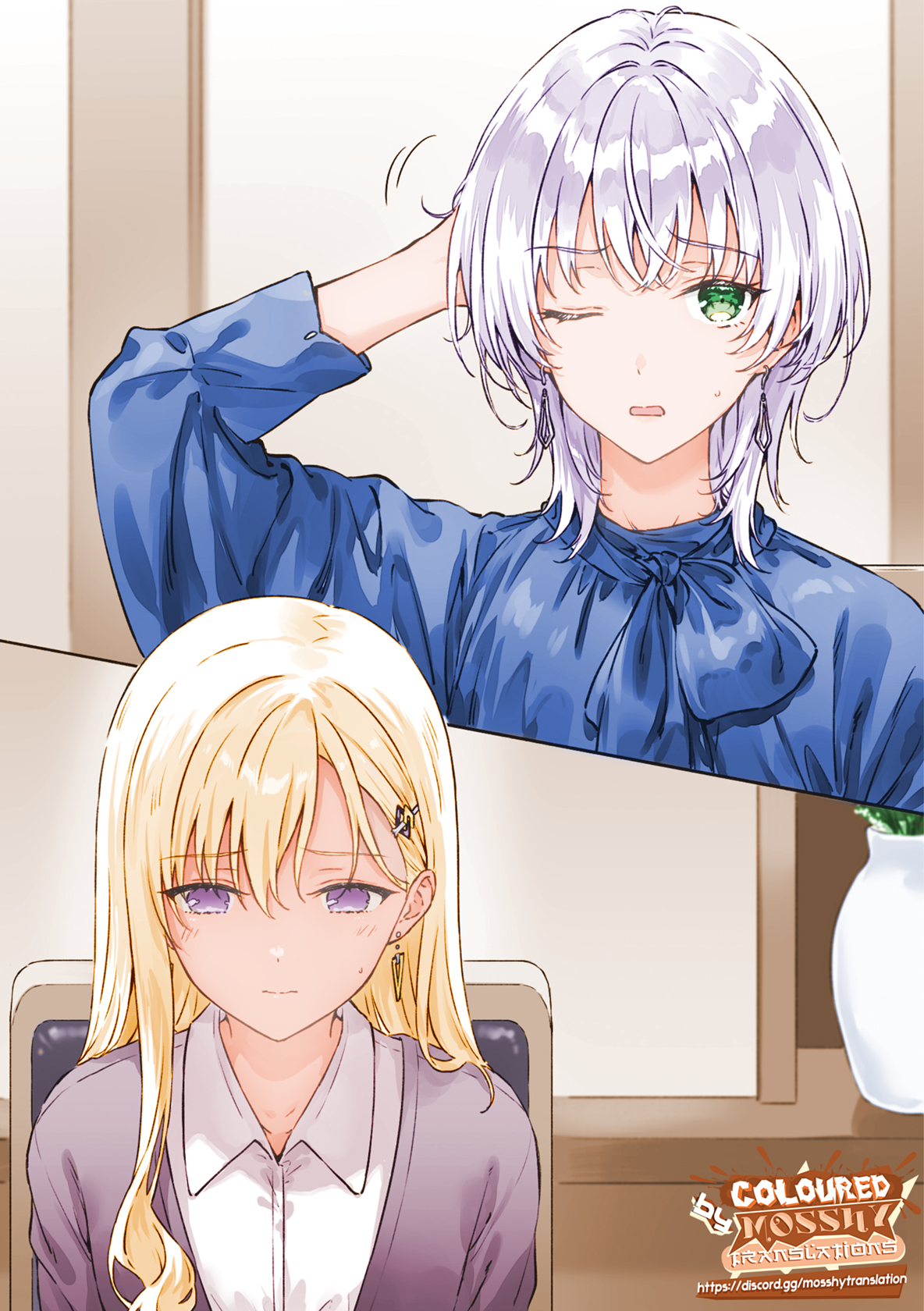
Just then, Maeda-san chuckled. “It’s alright, Ruka-san. You too, Ayase-san. It was clearly Iwamoto-san who was in the wrong just now.”
“I made you cover for us. I hope this doesn’t cause any trouble for you, Maeda-chan.”
“It’s fine, it’s fine. Lately, I’ve just been getting good at office politics. It’s been a while since I’ve seen someone go straight for the jugular like that. It was kind of refreshing.” Her smile and gestures conveyed that she didn’t mind, and I thought what a kind person she was.
But I couldn’t take her words at face value.
…Huh? Wait, Maeda-chan? Ruka-san just called her with “-chan”?
“Ah, I’m going to the restroom for a bit too,” Maeda-san said, rubbing her stomach jokingly. “The sake is starting to hit me.” Whether it was true or not, she left the room.
The fusuma closed, leaving just me and Ruka-san. Once all human presence had vanished from outside the room, I couldn’t hold it in any longer.
“Um… I’m sorry. I’m really…”
“Do you regret it?”
“…Yes.”
“I see. Then I’ll accept your apology.”
“Um… are you… angry… with me…”
Ruka-san sighed. “Well, in the old days, I think you would have been told, ‘That’s not okay. Don’t do it again,’ y’know.”
“You’re not going to say it?” Or rather, I was sure she was.
“If I said that in the Reiwa era, I’d just be branded a bad boss. I’m the one who brought you here, Saki. In that case, I have to take responsibility for your actions. It’s my job to manage risks.”
“That is…”
“What you did was extremely human. And unless it was inhumane or unethical, there’s no reason to stop you if you weren’t warned beforehand. I should have foreseen this and said something to you—that in situations like this, it’s sometimes necessary to swallow the bitterness and not show it on the surface.”
“You should have foreseen it… If you could, then perhaps that’s true. But you mean you could have predicted I would get angry?” I thought that was impossible, but Ruka-san nodded firmly.
“I can. Or rather, I could. Saki, when that guy came into the room, you read my expression, didn’t you?”
“Ugh.”
Ruka-san slumped onto the table. “I knew it. Ahh, damn it. That’s my blunder. I should have put on a genuine smile. If you had thought he was someone I liked, you wouldn’t have talked back to him like that.”
“That is…” That might be true.
“It means I underestimated your observational skills, Saki.”
“No, I was thoughtless. I am truly sorry. I won’t make the same mistake again.” I bowed my head.
Ruka-san glanced at me before resting her cheek on her hand again. “Yeah. Well, I’d appreciate that. But it’s probably impossible.”
Being told that felt like my heart was being squeezed tight. “Impossible, you say?”
“Because this isn’t the first time for you, is it? You have an inkling, don’t you? Of talking back to someone in a higher position.”
My words caught in my throat. I had more than an inkling. Associate Professor Kudou, my own father Itou Fumiya, maybe even Kozono-san. Kozono-san had shown her affection for Yuuta first, so in the context of romance, she had the upper hand. And yet, I had retorted with something like, “For such a confident line, you say ‘probably,’ huh?” Thinking about it now, I realized how terrifyingly quick I am to pick a fight.
“I’ll fix it.”
“Impossible, impossible. A leopard can’t change its spots, y’know. In my estimation, you’re a sore loser to the core. That kind of person shouldn’t wear themselves out with these kinds of negotiations. The secretarial work will be useful, but maybe this isn’t what you should be aiming for.”
That flat-out declaration hit me the hardest. It might have been easier to be scolded head-on, but Ruka-san wasn’t the kind of boss who would allow such an escape.
“But about this time,” she continued, “I’m sorry. The worst part was my own immaturity. Maeda-chan was there, so I should have been more composed. I shouldn’t have given you any room to worry about me.”
“Because Maeda-san was there… um?”
“You’ll understand eventually. The scariness isn’t about status or position, you see…”
Just as she said that meaningful line, the fusuma opened again. First, Takahashi-san returned. Then, Maeda-san and Iwamoto-san came in. I thought Maeda-san was in the restroom, but why was she with Iwamoto-san? Perhaps the restroom was just an excuse.
Iwamoto-san sat down, sullen and silent. From then on, the dinner proceeded as if nothing had happened, but he didn’t utter a single strong word for the rest of the evening. He seemed to have shrunk, and Takahashi-san looked at him with sympathetic eyes. Only Maeda-san, sandwiched between them, chatted cheerfully with Ruka-san.
As for me, I felt like I was sitting on pins and needles. I couldn’t even taste the horse meat that must have been delicious. While reflecting on my actions, I suddenly realized something. Ruka-san had praised my powers of observation, but in this room, they had completely failed to see the one person I should not have angered. Was there someone who hadn’t changed their expression at all, who had perfectly hidden their emotions under a smile?
By the time dinner was over, the night had grown quite late. After we parted ways, Ruka-san arranged for a taxi to take me to Shibuya. As we rode in the taxi speeding down the highway, she said quietly, “The time to draw your sword is when you can be certain you will defeat your opponent.”
Because once you draw it, you’ve declared the other person an enemy.
Even I, who has been told I lack reading comprehension, could understand what she was alluding to. I managed to nod.
“I was frustrated,” I admitted. “I felt like you were being looked down on, Ruka-san.”
“Mm.”
“But I’ll stop from now on.” Even if she said it was impossible, that wasn’t an excuse not to try. As long as I was allowed to continue my internship, I would do my best. After all, I took this job because I was interested in it.
“The goal isn’t to win,” she said.
“Yes.”
“In fact, sometimes it’s more important to lose gracefully. You mustn’t lose sight of the real goal.”
To Ruka-san’s words, I gave my deepest nod of the day. The taillights of passing cars streaked past the streetlights on the side of the road. Our taxi, driven by an elderly, grandfatherly driver, moved at a leisurely pace, the very picture of safe driving. I watched the backs of the cars that overtook us, and then happened to see, in one lane, the distinctive silhouette of a car that should have been long gone, caught in a traffic jam.
The driver wished us a good night, and after we replied, he drove off into the city to find his next fare. After parting with Ruka-san, I gazed at the night view of Shibuya and let out a small sigh. The lights of my apartment building, which should be visible beyond the darkness of the night, felt terribly nostalgic.
That night, for the first time in a while, I let myself be spoiled by Yuuta.
Lately, we’ve both been busy, and we’ve been spending less time together as a couple. Secure in our relationship, I haven’t felt the need to force any kind of act out of insecurity. But just for tonight, I needed to see his face. I needed to feel his warmth. I wanted him to fill the hole in my heart left by my failure, to warm my chilled spirit, to soothe my tense shoulders.
What a weak person I am, I thought. The past me, who felt I could navigate the waves of society all by myself, was a fool. So, to be honest, even as I said, “I want you to hold me,” I was a little scared. If I showed him my weakness, my sloppiness, and he was exasperated by it, or thought I only sought him out when I was feeling down—if I sensed even the slightest negative emotion from him, my heart felt like it would be fatally shaken.
But he—Yuuta—held me gently.
The body I hugged was slightly cool, and it occurred to me that maybe he, too, had something that wasn’t going well, something he was anxious about. It’s a strange thing to say, but I hoped so. Not that I wanted him to have had a bad experience, of course. It’s just that I hoped it wasn’t just me being supported, but that I was able to support him, too.
Me, and him.
How weak… and how happy we are, I thought.