● Freshman Year, May – Asamura Yuuta
The warmth in my arms was slowly drifting away, like a bonfire doused with water. As the heat on my skin rapidly cooled, a slight shiver ran through me. I wanted to reach out, to hold on to that fading warmth, but my arm felt numb and frozen, refusing to move.
In search of that heat, which seemed to be slipping far, far away, I—
I woke with a start, a shout caught in my throat.
Letting out a single, long sigh, I realized it was just a dream.
A dream, huh?
It seems I’d fallen asleep at some point.
Through hazy eyelids, I saw Saki’s face in the faint dawn light. Her long eyelashes trembled faintly as she slept, her light-colored hair fanned out in waves beneath her head. Calm, quiet breaths escaped her small lips. We were both naked, the blanket kicked off to our shoulders, exposing us to the cool morning air.
One of my arms was completely numb. Saki was using it as a pillow. No wonder I couldn’t move it, I thought with a wry smile. The trivial reality of it washed away the remnants of the dream.
“Achoo.” Saki let out a tiny sneeze.
I hurriedly pulled the blanket back over us, and the clock on the bedside table caught my eye.
6:32 in the morning.
It was Sunday, so I didn’t have university, just my part-time job at the bookstore later in the afternoon. There was still plenty of time.
Maybe I can let her sleep a little longer. I couldn’t imagine she had any errands to run this early on a Sunday. My old man was probably still asleep, too. On weekdays, he gets up around now, but on Sundays, he doesn’t usually show his face in the living room until after 8:00.
Still, he might be awake. It would be a problem if he got up to use the bathroom and bumped into Saki leaving my room. And there was also the chance my stepmother, Akiko-kaasan, might be coming home from work.
As I wondered what to do, I tried to carefully pull out the arm Saki’s head was resting on, but it didn’t go well.
“Ngh…” she murmured, clinging to me.
What was I supposed to do? Forcing my arm out would definitely wake her.
“…Ngyuma.”
What was that?
Her grip on my arm tightened, pulling me closer. I have no idea what she was dreaming about, but I nearly let out a yelp, quickly covering my mouth with my other hand. Did I wake her?
…Seems okay.
I continued to gaze at her sleeping face. It was only because I’d woken up first that I had this chance. If Saki had woken up in the middle of the night, our positions would have been reversed. The thought that we were both sleeping so defenselessly together filled me with a sense of security and fulfillment, a testament to how much we’d let our guards down.
A simple, honest thought surfaced: I want to cherish this girl clinging to my arm. The reality of having spent the night with her sank in, making the memory of my past self—the one who’d tried so hard to keep his distance—feel impossibly far away. I never wanted to let go of the closeness we had now.
“Hey.”
I flinched. At some point, Saki had opened her eyes and was staring right at me.
“…Not fair,” she mumbled.
“Huh?”
“You were the only one watching, Yuuta.”
“Well, that’s just because I happened to wake up first,” I said.
She pouted slightly, a look of dissatisfaction on her face. Then, with a faint heat in her eyes, she declared, “I won’t lose next time.”
What kind of competition is this? A contest to see who wakes up earlier? Is that it?
“If you win, you get to stare all you want, right? At my sleeping face.”
So the prize was my sleeping face.
“Is it really that fun to look at?”
“Totally.”
I didn’t think so. I’m pretty sure my sleeping face was just… normal.
“Well, it’s embarrassing. And this time, it was just a coincidence that I woke up first.”
“See?”
Huh?
“It’s embarrassing, right? To be watched.”
“Well… yeah,” I admitted. To have someone see my dumb, defenseless face while I’m asleep— Ah.
“Do you want me to call you a pervert?”
“I’m sorry,” I offered sincerely, and she let out a small chuckle.
“Just kidding.”
I breathed a sigh of relief.
“I wouldn’t call you a pervert just for staring at me sleeping,” she clarified. “It’s only okay if it’s fair. I just hate that it was unfair. If I’d woken up first, I would’ve gotten to stare all I wanted.”
“…I see.”
“I won’t lose when it comes to waking up early, so next time I get to stare at your face, Yuuta, okay?”
“…Alright. If that happens, I’ll be prepared.”
I don’t know if this kind of pillow talk is common, but for some reason, that little exchange made me oddly happy.
“Ah. Huh? It’s almost seven!”
Drawn by Saki’s gaze, I also looked at the bedside clock. It was already nearing 7:00. Panic set in. We could no longer afford to take our time.
“Shower. I have to take a shower!” Saki whispered urgently. “…But if I make any noise, Taichi-otousan might wake up.”
“Calm down,” I said, wracking my brain. A normal Sunday morning is…
“It’s okay. You sometimes take morning showers, so it’s not weird. Just sneak back to your room as you are, then go to the bathroom like you just woke up.”
“What about you, Yuuta?”
“It’ll be fine if I just wait a bit. I’ll go in a little while after you.”
Saki quickly got dressed and left the room, her footsteps muffled. As she walked away, I thought she seemed to be moving a little awkwardly, but that might have just been my overactive concern, not knowing how a woman’s body feels after… that.
I now recall how clumsy we both were, from beginning to end. I tried to be gentle, but I wonder how it really was for her.
In any case, by pretending it was a normal Sunday morning, we managed to pull through…
Probably.
The deepening green of the park revealed the changing seasons. Walking the morning path toward Shibuya Station, I stared at the dark shadows cast by the leaves and thought that summer must be near. According to the calendar, it was early summer.
The sky was a brilliant, clear blue, and the sunlight was strong. It was hot, to be frank. I let out a sigh as I walked up the gentle, long slope.
“Feels like summer,” I commented.
“We haven’t even had the rainy season yet,” Saki replied from beside me, her voice exasperated.
“Yeah, but lately, it feels like we don’t have spring. It’s like, summer one, rainy season, then summer two.”
“Is that so?” she asked, though it was really just my own feeling. I couldn’t help but wonder if Japan was becoming subtropical, though I hadn’t looked up any evidence.
I had only said it to make conversation. For me, even these trivial exchanges with Saki were fun. I found myself glancing to my side again. She was wearing a bright, lime-colored outfit. We’d graduated from high school, so neither of us wore a uniform anymore, a fact that still felt strangely new.
About two weeks had passed since Saki and I spent the night together.
I, for my part, had thought back on that night many times, thinking there was no going back. And yet, I didn’t feel like I’d changed. I just had some slight soreness the next day, likely from using muscles I didn’t normally use. I wondered how it was for Saki. I’d heard that some women can feel unwell after the experience… I’d never imagined I’d be worrying about the physical condition of the woman beside me like this.
“How’s university life?” she asked, suddenly turning to face me. My gaze swam in the air for a moment, startled by her abruptness. I wondered if she’d noticed me staring.
How, she asks. I couldn’t think of anything particularly new to report.
“Umm…”
“Ah, sorry,” she said quickly. “Was that too vague? It’s hard to answer when someone just asks ‘how,’ isn’t it?”
Did I make her worry? It’s in moments like these I’m reminded of how inflexible I am. I should know by now that when Saki asks things like this, she’s not looking for a “correct” answer. What she’s looking for isn’t an answer, but the communication itself. For someone like me who reflexively searches for a solution when asked a question, it’s a heavy burden. But she just wants to talk, so any answer that continues the conversation should be fine. She’s looking for emotional synchronization.
“No, I’m the one who should be sorry,” I said, deciding to start with an emotion. “It’s fun.”
But… Why do I feel it’s fun?
“There are a lot of interesting people.”
“Oh?”
“Lately, I’ve been eating with these guys, Nakamura and Kikuchi.”
“Oh, uh… the guys who sat next to you on the first day?”
“Yeah, yeah. You have a good memory.”
“Well, I’m also getting along with some girls I met by chance like that.”
Is that so.
“Was it your seat, too? —Ah.” I couldn’t help but ask her a question back, even though she was the one who started the topic. But this wasn’t a debate, so it should be fine. Still, I couldn’t help but worry. I needed to get used to this.
“She was behind me, rather than next to me,” she said, stumbling over her words, which was rare for her. “Yeah, well, I’ll tell you about them eventually, but I’m curious to hear about this Nakamura-kun and Kikuchi-kun. Are they interesting?”
An embarrassed look flashed across her face for a moment, which made me curious, but if she was putting it off, I couldn’t press her. I decided to tell her about my new friends, Nakamura Hironobu and Kikuchi Yuuma.
Compared to my high school days, where my only friends for three years were Maru, Yoshida, and maybe Shinjou, my university life—where I’d already become close with two people right after enrolling—felt groundbreaking. What’s more, they were what you might call “bad company,” a first for me.
Could it be that Saki has made friends like that, too?
No, I was overthinking it. At a glance, Saki might seem like a gyaru who’s used to playing around, but I knew her armor was a result of aiming to be both a “beautiful woman” and a “capable woman,” modeled after her stepmother, Akiko-kaasan. Inside, she was straight-laced.
Right now, I should be enjoying my conversation with Saki, not indulging in baseless fantasies, I thought, and told her about the two friends I’d recently met. She listened quietly as we walked to the station.
The azaleas blooming in the bushes beside the park were also nearing the end of their season.
The first two years of university are a time for mastering the fundamentals.
I thought about this as I traced the path of the chalk from the back of the lecture hall. These two years are called the “general education curriculum” or the “foundational course.” People tend to think you’ll be studying a specialized field in depth, but before that, you need to master the basics and acquire a wide range of knowledge. That’s what this curriculum is for, requiring students to diligently take foundational courses in languages, natural sciences, humanities, and social sciences.
Of course, that doesn’t mean it’s boring or easy. In fact, it’s not easy to keep up. Without preparation and review, some classes can be difficult to even understand.
On the other hand, some lectures are surprisingly easy to follow. For example, the one I was currently in: “Consumer Behavior.”
The lecturer was explaining how consumers can be classified based on their receptivity to new things, according to Rogers’ “diffusion of innovations” theory. I think many people have heard the terms: Innovators, early adopters, early majority, late majority, and laggards. In short, while some people will accept something new just because it’s new, others steadfastly use what they’re familiar with. Rogers’ theory properly classified something that, once you hear it, everyone can relate to.
Interestingly, this classification can be applied to any group with a similar composition ratio. Innovators make up about 2.5% of any group. Those who feel value in something just because it’s new are only about five out of two hundred people.
Murmurs of “Huh” and “I see” came from around the lecture hall. Observing the reactions, it seemed many students didn’t know about this. Some were even tilting their heads in confusion.
“Why’d they gotta go and classify stuff with such troublesome names?” Nakamura muttered from my left.
Kikuchi, sitting to Nakamura’s left, also tilted his head. “I agree with Hiro on this one. Customers are customers, aren’t they?”
They both looked at me. Eh, what do they expect from me?
“This theory is what classifies those customers into five types based on their characteristics,” I explained.
“Yeah, so why’re they goin’ to the trouble of separatin’ ’em?” Nakamura pressed.
Why classify them, huh?
“Well, if you keep listening, I’m sure he’ll explain it.”
And just as I said, the lecturer did, but even after hearing the explanation, Nakamura and Kikuchi still didn’t seem to get it. I think the easiest thing to stumble on in academics is encountering a new concept. Even if it’s simple once you understand it, people have a hard time accepting a new way of thinking.
After class, the two of them, still tilting their heads, begged me to explain, so I ended up simplifying it for them.
“The fact that there are different types of customers means the way you advertise to them changes, and how they access information changes too,” I began. “So, I think there’s a point to classifying your consumer base.”
People who like new things actively hunt for new product information in magazines, while people who only want familiar things don’t. The way you should advertise to them is different. It was the same at the bookstore. The shelf for a new author’s debut work is different from the shelf for a classic masterpiece. It’s the same idea.
I already knew about this from a book I’d read, thinking it might relate to my part-time job. It was interesting, so I read other related books and eventually got sidetracked into behavioral economics, which was purely a hobby. I explained as carefully as I could, mixing in my experiences from my bookstore job.
“I see. So they’re different customers, even if they look the same, yeah?” Nakamura concluded.
“Right, right. Think of it like classifications for ‘men,’ ‘women,’ ‘adults,’ or ‘children.’ This is just about how your approach to new things also affects how you buy things.”
“Asamuu, you read books like that?”
“You’re a weird one, Yuuta,” Kikuchi added.
Nakamura looked at me as if I were a strange creature. No, no, what are these two talking about? The “diffusion of innovations” theory originated in sociology, and they’re supposed to be sociology students, too.
“I just happened to know about it,” I said.
Still, from the lectures I’d attended, this professor’s classes often featured familiar content, almost as if he were speaking along the lines of what I’d already read. Which meant it wasn’t that fresh for me.
Rather, it was the latest topics he would bring up at the end of the lecture that piqued my interest. Content he would digress into, then give a wry smile and say, “Well, this might be a bit difficult for first-years.” The bell would always ring right then, and I suspected he was doing it on purpose to stir the students’ interest.
As our lecturer finished summing up, Nakamura said, as if he’d just remembered, “Hey, Yuuta. Wanna go out for lunch today?”
“Out? You mean, off-campus?”
“Yuuma found a good place,” Nakamura said with a thumbs-up. Behind him, Kikuchi nodded.
“A senpai from my circle took me.”
“Oh?”
“It was good. I think you’ll like it too, Asamuu.”
Hmm, I thought for a moment. I had planned on getting the fried white fish with egg sauce, rice, and miso soup from the cafeteria. The combination didn’t exceed 500 yen, making it the most cost effective. My family has a mindset of “don’t be stingy with food,” but I couldn’t waste money, either. Making a bento would be better, but waking up 30 minutes earlier was tough.
It’s been over a month since I started university, and I’ve realized it costs far more money than high school. A bit of a saving mindset had started to sprout in me. Tuition is high, textbooks are expensive, commuting is expensive, and surprisingly, socializing had become expensive, too. When I went out with Maru, we’d often spend hours at a fast-food place with just coffee, but Nakamura and Kikuchi eagerly discovered new shops and invited me. My funds wouldn’t last if I went with them every time.
“Apparently, it’s the soul food of Ichinose University students,” Kikuchi added.
“Sounds interestin’, right?” Nakamura chimed in.
Soul food, huh… something rooted in a specific culture, evoking nostalgia. It probably just meant every student at this university had eaten there at least once. When they put it that way, even a laggard like me became interested. If it was just one meal, it probably wouldn’t be that expensive.
“Alright. If you’re going to say that much, I’ll join you.”
“It’s a deal! Time is precious, so let’s get goin’!”
The three of us—me, Nakamura, and Kikuchi—walked down “University Street” towards the station. Just as the roundabout came into view, we turned left into a narrow alley.
“Look, that’s it,” Kikuchi said, pointing to a white sign typical of what you often see on shopping streets. Beyond it was a deep, slightly greenish-blue door with a small blackboard menu hanging beside it.
When we opened the door, we found a calm, not-too-spacious interior. I thought it wasn’t very crowded, but then I heard there was a second floor. It was a surprisingly large place. The three of us took a seat in the back and looked at the menu.
Toast, gratin, pizza, curry… they had all the standard Western dishes. Since it was my first time, I didn’t know what to choose.
“What do you recommend?” I asked Kikuchi.
“The curry is famous, apparently. But I recommend the beef stroganoff.”
Oh.
“Is it good?”
“Of course. And, it’s huge.”
“Huge?” I tilted my head. I could understand “huge” for a hamburger steak, but beef stroganoff? I could see “a lot,” but not “huge.” I didn’t remember eating it much, and it seemed interesting.
“It’s a traditional Russian dish, right?”
“That’s right. I’ve never been to Russia and eaten it, so I don’t know how authentic it is, but it’s probably what you’re imagining.”
“Sounds good. I’ll have that,” Nakamura decided. “What about you, Yuuta?”
“I’ll have the same.”
“It’s decided. I want the curry I couldn’t have last time,” Kikuchi said.
And so, Nakamura and I ordered the beef stroganoff, and Kikuchi ordered the curry. The food arrived quickly, probably because we’d beaten the lunch rush.
It was placed in front of me with a thud.
“Whoa.”
It was huge. I see, I thought. This should indeed be described as “huge.”
This place’s beef stroganoff was served on a large platter split in half—one side with rice, the other with the stew—but the amount was extraordinary. My image of a stylish dish was shattered. The rice was piled high like a mountain, and the thick stew was poured to the point of overflowing. The visual impact was outstanding.
“It’s huge, right?” Kikuchi asked. I replied with a nod, “Yeah.” I was already satisfied. It was a menu designed for growing university students.
Just as I was about to tackle the mountain, a strange sight caught my eye. “What are you doing?”
Nakamura was pointing his smartphone at his plate.
“Just postin’ it on Insta.”
“A picture of your food?”
Insta is an SNS app for posting photos… apparently. I knew it existed, but I’d hardly ever seen it. Come to think of it, Saki—
“Alright! Got a good one!”
“It’ll get cold if you don’t eat soon,” Kikuchi said, already busily moving his spoon. “Afternoon classes are starting, too.”
“It’s fine, it doesn’t take that long. It’s a habit.”
“You mean, you take a picture every time?”
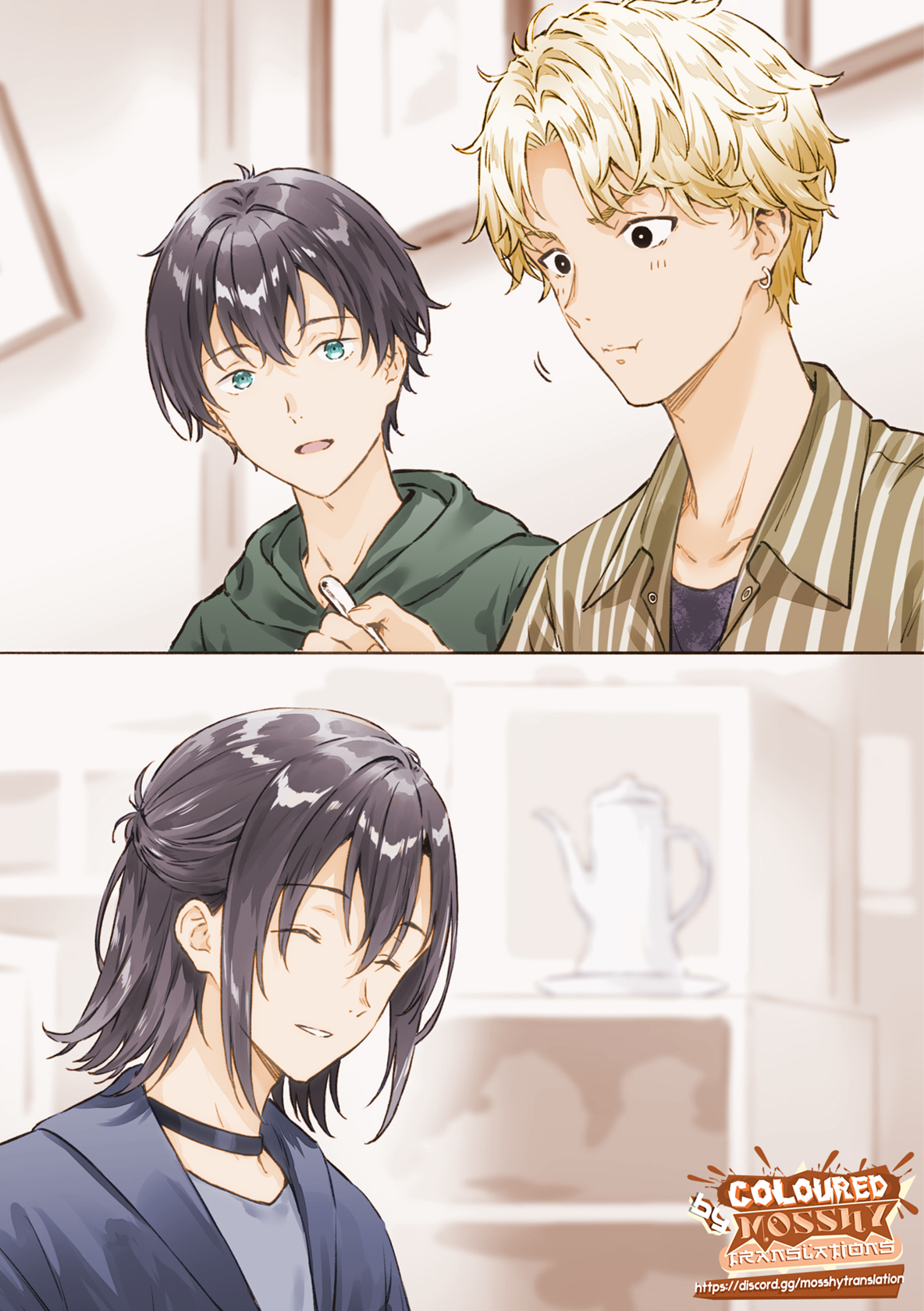
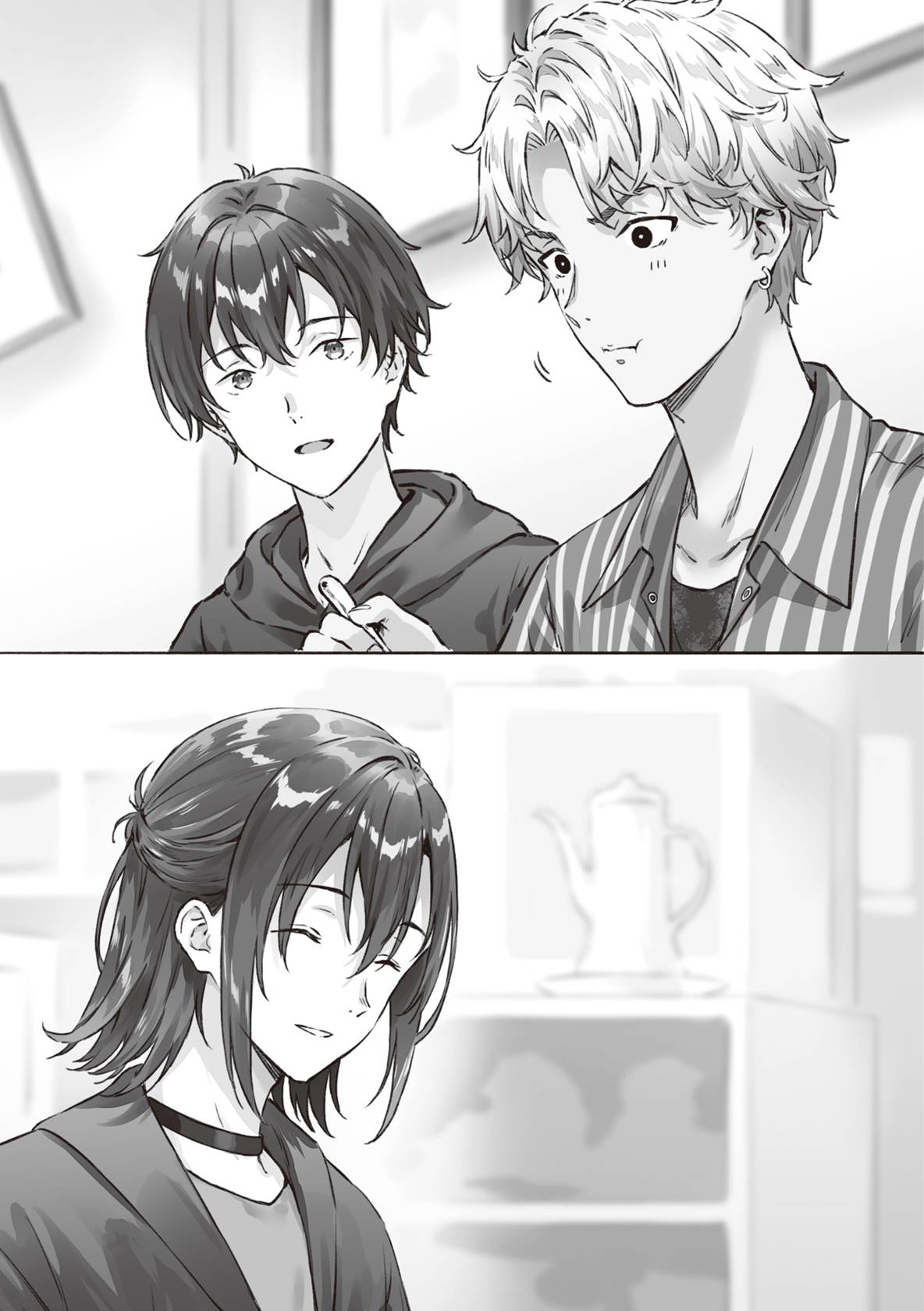
“When I’m out, yeah. Ya wanna share interestin’ stuff like this, right? Food’s all the same once it’s in yer belly, but… y’know?” he said, forcing a standard Japanese accent.
“You don’t have to force yourself to speak in standard Japanese,” I pointed out. Nakamura’s base dialect was from Kansai, but he was trying to get closer to standard Japanese, and it was starting to break down his natural speech.
“Matchin’ the other person’s way of speakin’ is a part of communication,” he explained. “And with interestin’ stuff like this, I’d rather share it with someone than keep it to myself. It becomes a topic of conversation later on, too.”
“A topic of conversation later on…” When he said that, my perception of him changed a little. I’d always thought of popular people like Narasaka-san, Maru, and Yoshida, but Nakamura was a type I had never met before.
“By the way, Yuuta, you don’t have Insta? I don’t use LINE much lately, so it’s inconvenient for contactin’ people.”
“You use Insta for contacting people?”
“Yeah. If we’re followin’ each other, we can, right? It’s easy to contact Yuuma on there anytime.”
“Oh, Asamuu doesn’t have Instagram?” Kikuchi asked.
“Umm. I think… I have an account,” I said, just remembering. Last year, I went with Saki to her friend Melissa’s concert and met a designer named Akihiro Ruka. Saki created an account to see her illustrations, and I made one in the flow of things but never posted anything.
“It’s an account I haven’t used at all, but if it’s easier for you, I’ll send it to you later.”
“Thanks, man. Well then, shall we eat?” He put away his phone and began to eat. The large amount of beef stroganoff disappeared in no time. “You’re not eating, Yuuta?”
“Eh? Ah, yeah. I’m eating, of course.” I had been spacing out, strangely struck by Nakamura’s words.
I took a spoonful of the brown stew. A slight sourness cut through the creamy taste. According to Kikuchi, it was from sour cream. The beef was thinly sliced and easy to eat, intertwined with mushrooms and onions. It was delicious.
“It really is delicious,” I said.
“Right?” Kikuchi smiled brightly, a childlike expression replacing his usual cynical air when he talked about good food.
I tried it with the rice next. The rich flavor was softened, and it was just as good. I swallowed the hot food while panting, and after a sip of water, I was already eager for the next spoonful. This was unstoppable.
“This is damn good. I’ll write a review later,” Nakamura said.
“On Instagram?”
He nodded. So he wasn’t just posting photos, but comments as well. We talked a little while eating. Nakamura said he mainly posted food pictures but added reviews when something was delicious, driven by that feeling of “wanting to share interesting things.” Kikuchi had a lot of gaming friends on social media and mainly used Discord to contact them.
“You guys use a lot of different things,” I observed.
“Discord is useful. You should try it too, Asamuu.”
I replied that I would think about it, not confident I could manage too many apps.
“I use Instagram too, by the way. Mine’s like this,” Kikuchi said, showing me his phone. Most of them were snapshots of everyday scenery. He also posted photos that showed a little of himself, like “got a haircut,” without a full face reveal, and pictures of clothes he bought. When I said it was like a progress report, he agreed. He claimed to be “not good with popular people,” but it seemed that even though he was introverted, he didn’t like being alone. Both of them were actively using it, exchanging comments and talking with friends. “I have more friends from gaming than in real life, though,” Kikuchi said with a wry smile.
“If ya save it in a photo, ya can always look back on it, right?” Nakamura said, shoveling the rest of his food into his mouth. “Like, ‘That was a fun time.’”
“Though there’s also the possibility it’ll become a dark part of your history,” Kikuchi countered.
“Then just delete it,” Nakamura said casually. That kind of decisiveness was something I lacked. “It’s better to do somethin’ and regret it than to regret not doin’ it, right?”
“This is why confident people are such a handful,” Kikuchi sighed. “I don’t want to regret anything in the first place. I mean, there are actions that you can’t take back.”
“Ah, that’s true. Doin’ somethin’ without bein’ prepared to take responsibility is the worst. That’s no good.”
Isn’t this conversation going off-topic?
We finished our meal as the topic continued to derail and returned just in time for the afternoon lecture.
On the rocking train to Shinjuku, I gazed at the darkening scenery and recalled what we’d talked about during lunch.
I remembered Maru saying he mostly discussed anime with friends online and had met his girlfriend, Narasaka-san, through social media. It struck me again that I’ve always had a stance of “not chasing those who leave and not rejecting those who come,” rarely making friends myself. Maru and Narasaka-san might be the first friends I’ve felt so strongly that I don’t want to grow distant from. It was probably then that I truly realized connections with people will suddenly break if you don’t actively try to maintain them.
I thought of the time when Saki, who had been calling me a distant “Asamura-kun,” suddenly called me “Nii-san.” Being called “brother,” a closer term, for the first time made me feel the distance between us. I was bewildered by that sense of distance, and felt a loneliness. From there, we acquired the strange, balanced position of being both brother and lover, a distance where we try to be lovers rather than siblings. And I don’t want to lose that.
I now understand that the stance of “not chasing those who leave” is a habit I acquired from my biological mother leaving. A way of not placing excessive expectations on my connections with people. If you don’t expect anything, you won’t be disappointed.
In the past, my position on that was sharply pointed out to me by Fujinami-san. —If you were truly neutral, you wouldn’t whisper to yourself, ‘I don’t expect anything from women.’ The fact that you emphasize only that point means that you’re not neutral. It’s the flip side of being conscious and wavering.
Now, I have expectations for Saki. And I think she has expectations for me, too. I want to live up to them. I want to cherish my relationships. The first person who made me feel that way consciously was Saki. But through my high school years, I slowly nurtured those feelings, and now I cherish my relationships with many more people.
The red-dyed scenery flowed past the window. The train continued forward, throwing the cityscape into the dark, sunken sky behind it, into the past. The scenery that passes by in an instant is like the memories of each day. Only a small fraction can be remembered, and the rest disappears into the darkness.
If you don’t want something to disappear, you have to take action yourself to hold on to it. Just like Nakamura posts pictures of his meals on Instagram.
‘It doesn’t take that long. It’s a habit.’
Yes, what’s important isn’t a great effort, but a small mindset that can be turned into a habit. Kikuchi, who takes a selfie when he buys clothes that suit him, is probably the same. He’s imposing a small habit on himself so that he doesn’t lose sight of what’s important. The realization shocked me a little.
I had vaguely thought that if my environment changed, something new would begin. Hadn’t I been thinking that new things would just come to me on their own?
“Have I tried anything new?” The small words slipped out as I leaned against the wall by the door. The train was mostly empty, and my whisper disappeared into the sound of the wheels.
I haven’t joined a circle, and my part-time job is the same. My relationship with Saki took a step forward, but looking back on this past month, am I not just repeating the same old life? A feeling of being the only one whose world isn’t expanding washed over me. Even though Saki has started a new job.
Come to think of it…
I took my smartphone out and looked for the Instagram app. I wasn’t used to it and couldn’t even remember the icon. After finding and launching it, I tapped on Saki’s account. The screen filled with thumbnails, so many that they couldn’t fit on one screen.
“That’s… a lot. Since when?”
I scrolled up, but the row of thumbnails never ended. Saki started Instagram last fall and had posted occasionally, but the number of posts had increased sharply since she entered university. It wasn’t just a feeling. A picture of cherry blossoms marked the turning point; the photos from then on were from this spring.
The number of photos was surprising. When had she taken so many? A landscape of the university campus; a selfie with two friends (a girl with energetic orange-ash hair and another with a gentle feel). There were also pictures of stylish accessories, her nails, and new things she bought.
She also posted the standard food pictures, alternating between eating out and home-cooked meals she made herself, which was very Saki-like. The home-cooked meals were mostly stylishly decorated appetizers—in other words, snacks for her old man’s beer. A dish of crackers layered with cheese and topped with colorful paprika and fruits was gorgeous, looking like something from the bar where Akiko-san works. It might have even been a direct recipe from her.
And then, numerous pictures of sweets. The last one was of what seemed to be freshly baked scones and tea, with blueberry jam and white cream next to the sugar pot.
Ah, this must be from the famous scone cafe in Ginza. She had explained it to me while showing me this picture, saying the large scones and clotted cream were exquisite. At the time, she also said she wanted to try an English-style afternoon tea someday.
I think that was about two weeks ago. I remember because I looked it up as a candidate for a date, but to my surprise, afternoon tea was at least 4,000 yen, with some places charging as much as 8,000 yen—not something a university student could casually afford.
Even so, the recent photos were all ones I was seeing for the first time. My smartphone screen was overflowing with a Saki I didn’t know. Until high school, our spheres of life overlapped, and I never thought there would be such a difference between the world she sees and the world I see.
Even though we see each other and talk every day, I feel like the number of things I don’t know about her is increasing. Even at dinner, she sometimes seems distracted, giving half-hearted replies.
Saki’s daily life that I don’t know about—huh.
The train slowed down, and an announcement signaled our arrival at Shinjuku Station. This was my transfer. As I got off, I saw the eastern sky was already sinking into blackness. It felt as if this day had been swallowed up without a trace.
There’s a thing called a “base” for takikomi gohan. You often see them in retort pouches, but you can also buy a “base” in a plastic pack with seasonal vegetables pickled with dashi at the supermarket. It was surprisingly convenient. You just throw it in the rice cooker with the rice, and the meal looks more luxurious than plain white rice.
[Note: takikomi gohan is a Japanese dish where rice is cooked together with other ingredients kind of like Chinese Claypot rice except that takikomi gohan is made in a rice cooker.]
So, since I was in charge of dinner tonight, the bamboo shoot rice base came in handy. The season for bamboo shoots is from March to May, so if I didn’t eat them now, it’d be over soon. The rice cooker announced it was done, and after letting it steam, I opened the lid. The rising steam and the dashi-infused aroma of bamboo shoots covered my face, and my stomach growled.
“Yeah. It’s cooked just right. Can I serve it?” I called out to Saki, who was working in the living room, a university textbook open as she diligently wrote in a notebook.
“Yeah. Let’s eat. I’ll help carry everything,” she replied.
“Thanks.”
I arranged the dishes on the dining table: bamboo shoot rice, miso soup (homemade now, unless I’m short on time), a salad with diced tofu, and natto.
“Single-serving packs of natto are so convenient, aren’t they? …Plum flavor?” she noted.
“It looked interesting, so I bought it.”
“Oh.”
The Asamura family usually has plain natto, but since I was on shopping duty, I’d picked up some things we don’t usually have. A commendable effort to break from the “usual” by starting small. Though it was a very modest start.
We put our hands together and said, “Itadakimasu.”
It was a bit early for dinner, but my dad had messaged that he was meeting Akiko-kaasan for dinner before coming home since it was her first day off in a while. Eating too late isn’t good for you, after all.
Our conversation was filled with small things, reports on our daily lives, comments on the news. Movie-like events don’t just wander into the lives of ordinary people. But I didn’t find it boring. If I wanted drama, I could read a book. But no novel could tell me about the Saki in front of me. And an individual’s personality is as strange, mysterious, and interesting as a masterpiece of science fiction. If a movie existed that just observed Saki’s daily life, I would watch that slice-of-life film of my stepsister without getting bored. A single small gesture from someone I have feelings for can shake my emotions greatly. Well, that kind of thinking is a bit stalker-like and scary, huh.
“Are you listening?”
“Eh? Ah, of course.”
“You seemed to be spacing out. Are you tired, maybe?”
“I’m fine. I was just thinking about something,” I apologized for my half-hearted reply and, as an apology, started talking about my lunch outing with my new friends and the delicious beef stroganoff. As I talked, I took out my smartphone.
“Oh yeah. My friend took a picture.”
“Eh?” Saki looked surprised.
Not knowing why, I launched Instagram and went to Nakamura’s account. “Here.”
“Huh? …Who is this?” she asked, noticing it wasn’t my account.
“That’s Nakamura. One of the new friends I was talking about. It’s a habit for him to take pictures of his food. See, this is the beef stroganoff.”
“I can see that it’s beef stroganoff, but, huh, so you didn’t take a picture, Yuuta?”
“I thought about it, but by then I had already eaten half of it. Besides, I don’t really take pictures of what I eat.”
“Right. You surprised me,” she said, and I realized she was surprised because she thought I had posted it.
…Am I so not the type of guy to do that that it would be that surprising?
“Come to think of it, Saki, you’ve been posting a lot on Instagram lately, haven’t you?”
“Yeah. A little. I’m trying my best with it.”
Trying your best? What does that mean? I tilted my head mentally but continued the conversation, showing Nakamura’s picture again. “This was pretty huge. It was so big it filled me up completely.”
Saki stared at the picture for a moment and murmured, “…It’s a shame, but you can’t really tell how big it is from this picture.”
“Eh, really?” I turned the phone around and checked. You can’t tell? “It was about this big,” I said, making a circle with my fingers.
“That,” she pointed out. “The size you’re making with your fingers is bigger than the smartphone, right? Which means you can’t tell from just the picture.”
Ah…
I lowered my gaze to check. “But this plate was really big. Oh, I see. I only think that because I actually saw it in person… Is that it?”
Saki nodded. “Can you explain that in a bit more detail?”
“Umm, okay. I can tell it’s a large portion because it’s filled to the brim. But, like you just said, I can’t tell the actual size of the plate, and I can’t tell how high the rice is piled from this picture.”
Ah. I see. “Then, what should he have done?”
“There’s no comparison, so it’s hard to get a sense of scale. If he had at least included a spoon in the shot, you could tell. A spoon, or a glass. Or even another dish. With beef stroganoff, the meat is thinly sliced and buried in the sauce, so there’s not much to judge the size by. It would have been good if even one sliced mushroom was clearly visible. I guess I’d have to estimate from the size of the rice grains.”
“From the rice grains…?” Are you Sherlock Holmes?
“Also, a picture from a slight angle instead of directly from above would have shown the height of the rice pile better.”
“O-Ohh.”
“Ah, sorry,” she said, looking bashful. “I’m not trying to criticize. I’ve just been paying more attention to that kind of thing lately, so it just slipped out.”
“Eh? Then, the pictures you post, Saki…” I hurriedly switched to her account and looked at her pictures with her advice in mind.
“Hey! I told you, it’s embarrassing!”
“Hmm. So, for example, this picture of a cake. Did you take this while thinking about those things, too?” I pointed to a picture of a plain-looking rare cheesecake.
“This? Umm, rare cheesecake is white, right?”
“Yeah, it is.”
“So I was careful not to let any shadows fall on the cake. It wouldn’t look as delicious if it looked black. Also, the bottom of a rare cheesecake is like a cookie, right?”
“Ah…” I understood immediately. From directly above, you couldn’t see the cookie crust. That’s why she took it from an angle.
“Also, the beauty of the cross-section, and the sense of scale. I placed a single spoon next to the plate before taking the picture. I also deliberately placed a glass of water in the blurred background. Of course, if the best part of that cake was somewhere else, I’d use a different technique.”
“Ooooh.” I thought she was just taking pictures and posting them…
Saki, looking a bit embarrassed, explained that since she started working at Akihiro-san’s office, she’d been actively using Instagram because all the designers there were masters of it. Her designer senpais gave her advice, so she’d gotten into the habit of thinking while taking pictures.
I was a little shocked. The company Saki is interning at is a design office. Now that she mentioned it, it made sense that people working there would put thought into a single picture. But for her awareness to change this much…
“I’ve been told to always think about how things look to the person watching,” she said. “And I realized something. This is the same as when I was working part-time at the bookstore.”
“The same?”
“At the bookstore, you often said it too, Yuuta. That when you arrange the books, you think about how they’ll look to the customers.”
Ah. I see.
“My Instagram account isn’t seen by that many people,” she continued. “But when you take a picture, there’s a part you want to capture, right? Like, ‘this is cute,’ or ‘this is pretty.’ But capturing that doesn’t mean that feeling will be conveyed to the person looking.”
“I get that. With books, too, just lining them up isn’t enough for them to be discovered.” Just because you’ve discovered the beauty of something doesn’t mean others will immediately understand.
“Yeah, right? I get it now, too. So, I thought I should get into the habit of thinking so that the part I want to convey is properly conveyed.”
In her expression, I could see the same excitement a child has with a new toy. Considering how she used to wear her “armor” and fight the world in high school, this was a very happy thing. As both her brother and her lover, I wanted to support her. Her expression warmed my heart.
But deep down, a feeling of envy welled up inside me.
“Ah, but, the deliciousness of the beef stroganoff comes across,” Saki said, hurriedly praising the picture, likely remembering he was my new friend. “What didn’t come across was the size. If the most important thing was that it looked delicious, then this is perfectly fine…”
I wished she wouldn’t be so considerate. She wasn’t trying to find fault; the words had just slipped out. I understood that. “Yeah. It was delicious.”
After saying that, a thought occurred to me. “Come to think of it, beef stew and beef stroganoff are similar, aren’t they? What’s the difference?” I thought Saki, who is good at cooking, might know.
She answered immediately. “The way the meat is cut, and the seasoning, I guess.” She then explained in detail. “Beef stew is a French dish, where the meat is simmered in chunks. Beef stroganoff is a Russian dish, where the meat is thinly sliced and sautéed. So, you don’t need to simmer it for as long.”
“Oh, so they’re different from the very start.”
“The seasoning is different, too. Beef stew uses demi-glace.”
“Domi…? Not demi-glace?”
“It’s the same thing. ‘Demi’ means ‘half’ in French, but the correct pronunciation is something like ‘deu-mi.’ So for Japanese people, both ‘domi’ and ‘demi’ are correct.”
“Ah, like the ‘demi’ in demi-human.”
Saki tilted her head.
“Ah, no, forget it. Just talking to myself.” Demi-human means half-human, a word from sci-fi or fantasy. Also translated as “ajin.”
“I don’t really get it, but probably. It means a sauce that’s been simmered down by half. In contrast, beef stroganoff uses sour cream.”
“That’s what Kikuchi said, too. That the sour taste is because of the sour cream.”
Saki nodded again. “There are other minor differences, but that’s about it.”
“Come to think of it, the beef stew we ate at that restaurant before didn’t have that much of a sour taste.”
“Right?”
“Well, either way, it’s hard to replicate the taste of a restaurant at home,” Saki said, something I felt I’d heard before.
“I wonder if I’d understand if I made and compared both.” Taste can become surprisingly vague once it’s a memory. I don’t think I could ever become a chef or a gourmet.
“I don’t think I’ve ever properly tried making beef stroganoff myself.”
“Well, I could try making it.”
“Yeah, you’re right. I think you could. It’s known as a home-cooked meal, after all. I’d like to try making it myself if I get the chance.” As expected, if you have a question, you have to try it out.
As we were talking and eating, just as I was about to finish my rice, Saki blurted out, “By the way, Yuuta—”
“Hm?” I looked up.
“What do you think about ‘papa-katsu’?”
For a moment, the word didn’t register. And when it did, I want to praise myself for not spitting out my miso soup.
Eh, what do you mean? Whether she noticed my inner turmoil or not, Saki continued with a troubled expression. “Are there really people who would pay ten or twenty thousand yen just to talk to a girl?”
I stealthily observed her expression. I’ve seen this look before. The face she had when she was thinking in circles, unable to grasp the psychology of characters in a literature problem. She’s being serious. I should answer her seriously.
However, umm… ‘Papa-katsu’? I don’t know anything about that world.
“Just to confirm,” I began, needing to establish a shared premise. “The ‘papa-katsu’ you’re talking about, is it that ‘papa-katsu’?”
“Are there that many kinds of papa-katsu?”
“No, well, you know, like, paparazzi activities, or… parapara katsudou, you know.”
She gave me a weird look. Why was I getting the “what are you talking about” look?
“I don’t think it’s that kind of thing.”
“Right.” So, it’s that. An arrangement between a young woman who wants financial support and a man who wants to support her. It sounded like Jean Webster’s ‘Daddy-Long-Legs,’ though my memory of the book was hazy.
Well, that’s not what we’re talking about right now.
“I think it depends on the reason for paying,” I said.
“The reason for paying?”
“It’s a matter of what you’re willing to pay for, and up to what amount…”
“Umm, probably, just… talking to a girl?”
That was a wholesome kind of papa-katsu. For now, I’d think of it as the ‘light’ version. The proposition was whether one could pay that much “just” to talk to a woman.
“In that case… I think it depends on the content of the conversation.”
“The content of the conversation…”
After seeing Saki lost in thought, I put tea leaves and hot water into the teapot. “Do you want some tea?” After confirming, I poured some into her small, cherry-blossom-patterned teacup. Mine was a large one my dad got from a business trip, the kind you see at a sushi restaurant with fish names written on it. It was just a gesture to buy time anyway.
“Um, so, you know. When you want to pay to have a conversation, it’s either because the content has value, or the act of conversing itself has value, right?”
Saki looked up at the ceiling, lost in thought again. “The content… you mean, you’d pay if the information was worth the money?”
“Right, right. It’s not limited to ‘information,’ though.” It sounded like industrial espionage. “For example, if you’re developing a product for young women and you want to hear their opinions.”
“I don’t think they’d pay twenty thousand yen for that…”
“Value is relative. If that amount feels small to that person, then I guess they’d pay it. An oil baron, for instance.” It was a rather extreme example. Oil barons don’t just walk around on the street. Probably.
“What you’re saying, Yuuta, is that someone for whom twenty thousand yen isn’t a big deal, or if the conversation has that much value, might pay. I see. So, what about the one where the conversation itself has value?”
“In that case, it doesn’t matter what you talk about; it becomes a matter of whether you feel value in the communication itself.”
“Is chatting really that much fun?” Saki was the type who didn’t find much value in that. But—
“Well, I have fun talking with you like this, Saki.”
“So, could you pay twenty thousand yen?”
I was at a loss for words. I didn’t know if that was a good thing, or not okay as a boyfriend.
“But, if you were to go abroad or something, Saki, and we couldn’t see each other for months… In that case, well… If we could talk for the first time in half a year, if I could hear your voice, I feel like I would pay even if the international call fee was twenty thousand yen…”
“That… I might do the same,” she admitted. I said it myself, but that’s probably not what you would call papa-katsu.
“To get back on topic, it’s about whether you feel value in the conversation itself, and if you don’t feel that the amount is high, then you would pay for it.”
“For a guy, is talking to a young girl really that much fun and valuable?”
“It seems like a hassle, having to carefully choose your words while talking.”
“You mean it’s not fun?” she asked, surprised, but that was how I saw it. The more different the other person is, the more careful you have to be. If I were an older, working man, and the other person were a young, female student, I would probably be the most mentally exhausted. There are too many differences.
It reminded me of first-contact stories with aliens, where you have to abandon your language and change yourself to the point of losing your humanity just to understand the other person. However, enjoying a conversation by being considerate of each other is what a conversation is. Just feeling good yourself wouldn’t be a true conversation.
Still, if you were to force it— “I guess you’d have to pay a price in advance, like, ‘I’m going to speak without being considerate, so please don’t get angry.’”
“That would be like saying, ‘I’m going to speak rudely, but please forgive me’… That seems rude in itself. I wouldn’t want to talk to someone like that, even for money.”
Saki would definitely think so. That’s why she “armored” herself, because she hated that.
After thinking that far, I understood the answer. For family or friends to have a fun conversation, money shouldn’t be involved. You should offer consideration; the idea of “I brought money home, so forgive my rudeness” doesn’t work in a family. That act destroys the family. I already knew. What happened between my biological mother and my father was exactly that. And it’s also the reason why tonight, my father is taking Akiko-san out to dinner on her first day off in a while.
It’s been almost two years since they remarried. They’re a loving couple because they’re consciously trying to be considerate of each other, using their past experiences. As their son, I have no objection. We’re university students now, not elementary schoolers who would sulk just because our parents aren’t at the dinner table.
“In any case, the feeling of ‘it’s fun to talk to young girls’ is a sensation I can’t really understand. Our ages are different, but my tolerance for solitude is also high.”
“You mean you’re fine with being alone?”
I nodded. I can kill as much time as I want with a book and have never particularly wanted someone to fill my loneliness. If I had, I would have tried to get a girlfriend in high school. The reason I became friends with Maru was a series of coincidences. In short, for me, who didn’t mind having only Maru as a close friend until my second year of high school, the feeling of wanting someone to talk to because I’m lonely is difficult to understand.
“The reason conversation is fun is because it’s with you, Saki, not because you’re a young girl. At least for me.”
“…Thank you.”
“Ah, no… yeah.” Oops. I felt like I’d said something quite embarrassing.
“But, I see. Yeah. I get it. In the end, whether you enjoy that kind of thing or not depends on the person…”
“W-Well. I think so. Yeah.”
“Is it fun to talk to me?”
“Of course.”
“Well then, since it won’t cost you anything , please feel free to use me as a conversation partner anytime,” she said with a mischievous look. Even if she said it like ‘We look forward to your next visit,’ it still meant consideration was necessary. Of course, I had no complaints.
“If anything, I’m the one who worries if you’re having fun talking to me, Saki.”
“Of course, I’m talking to you because it’s fun. Don’t worry.”
“R-Really? Thank you.”
I wonder how it looked from the outside: the two of us sitting across from each other, drinking tea and being shy. Still, this small time spent talking about trifles is very enjoyable, and I wouldn’t exchange the Saki in front of me for anyone else. If possible, I want this time to last forever.
I remember dinnertime in junior high. A few years after moving into this apartment, my biological mother left. In the house where I was left alone with my dad, who always came home late, I spent the nights alone. I always ate alone. However, I didn’t feel lonely. By that time, I had learned to enjoy the world of stories. A bento, cup noodles, or delivery was enough for meals. I would begrudge even the time to eat and would open a book, diving into space, another world, the past. It was fun. I remember when I finished the last page and looked up, the unchanging room, starkly lit, would come into view, and the spaceships, dragons, and demons that had surely existed there a moment ago had disappeared, leaving me at a loss.
My fundamental disposition hasn’t changed. Still—my growth over the past two years has been realizing that there is also a fun life in the real world when I look up from my books, thanks to the light-haired stepsister who came into my life.
If possible, I want this to continue. For the next year, and the year after that. For ten years, or even twenty. Across the table, the person who listens to me and whom I listen to—I want it to be Saki. Now that we have crossed a night from which we cannot return, I am beginning to draw such a future map.
A scene I saw in a dream in the past suddenly comes to mind. In a car, heading towards the sea. I’m driving, Saki is in the passenger seat, and in the back are our two children. A scene that made me feel embarrassed every time I remembered it. That’s getting way ahead of myself.
Still, that scene from my dream is something I want to make come true someday—
“I think I’ll go get my license,” I blurted out.
“A license… You mean a driver’s license?”
“Yeah. That’s right. I decided I want to get my license. Otherwise, I can’t drive.”
“That’s true,” Saki said, staring at me with a face that said, ‘Why are you stating the obvious,’ but my heart leaped at the thought.
That’s right. I’ll get a license. And we’ll go to the sea, Saki and I.
It’s not something as grand as expanding my world.
But I want to forge a new path, even if it’s just one thing.