●
● March 24th (Thursday) – Asamura Yuuta
The morning of our graduation trip’s third day was dedicated to Maru Tomokazu—in other words, a holy site pilgrimage.
Following the pattern from the day before, it was only natural that Maru, the expert on the area around Kandai-mae Station, would be our guide. He’d been brimming with enthusiasm before we even left the hotel, telling us to ask him anything.
I was grateful, but since this trip was something Ayase-san and I had planned to proactively nurture our friendships, I didn’t want to rely on him entirely. It feels burdensome to always be the one taken care of.
“I think I can handle the directions,” I offered as we were leaving the hotel, hoping to be useful. “I’ve looked up the route.”
“Alright, Asamura. I’m counting on you,” Maru replied, entrusting the role to me. So, I took the lead, guiding us toward our destination.
Today, Ayase-san and I have to be the ones to liven things up. We can’t keep letting Maru and Narasaka-san do everything for us.
As I walked ahead, Ayase-san quietly came up beside me and whispered, “You’re really fired up, Asamura-kun.”
“Of course,” I whispered back.
I’d messaged her this morning to remind her of our goal. The whole point of us planning this trip was so that Maru and Narasaka-san, who always took the lead, could finally relax while we took charge for a change. Right now, we weren’t living up to the ‘Give more in Give & Take’ spirit we’d aimed for.
It might be a little late, but I had to bring more energy from here on out.
“I’ll do my best, too,” Ayase-san added, her voice soft but determined.
“Yeah, but let’s make sure we have fun, too.” Maru and Narasaka-san always prioritize enjoying themselves. I wanted to learn from that mindset.
Clenching her fists, Ayase-san nodded. “You’re right.”
I pulled out my smartphone to confirm our destination. Maru’s chosen holy site was the area around Kandai-mae Station, which meant our first task was to get there. There were a few different routes, but I’d chosen one in particular.
“First, we’ll walk from the hotel to Shin-Osaka Station, then follow the tracks toward Minamikata Station,” I explained.
“We’re not taking the train from Shin-Osaka?” Ayase-san asked.
I nodded. “I was debating which route to take, but I figured we’d stick to just the Hankyu Kyoto Line this time.”
Our boarding point, Minamikata Station, was about a ten-minute walk south from Shin-Osaka Station along the tracks. “We could take the Midosuji Line for one stop and then transfer, but that adds a transfer,” I continued, explaining my reasoning. The three of them listened attentively, which made it easier to lay out the plan. I wasn’t rattling off line names from memory, of course; I was reading from the schedule I’d jotted down on my phone.
“Plus, I didn’t want to risk getting lost during a transfer. The station we’d get off at on the Midosuji Line is Nishinakajima-Minamigata Station.”
“Eh? That’s a different name from the one you just mentioned, isn’t it?”
“It’s a different station, apparently. According to the map app, we’d have to get off there and walk about three minutes to get to Minamikata Station.”
Everyone’s expression soured at the thought. The memory of the Shin-Osaka Station trap from our first day, where we’d wandered aimlessly searching for an exit, was still fresh. With our collective lack of directional sense, a simpler route seemed best. One trip through a real-life dungeon was enough. Of course, the transfer might have been surprisingly simple, but I wouldn’t know if this was the right call until it was over.
“Also… everyone really went all-out at the breakfast buffet,” I added with a grin.
At that, Narasaka-san rubbed her stomach. Maru had already told her she was eating too much.
“But it was just so good! Tomo-kun, everything in Osaka is delicious, isn’t it?”
“Well, I won’t deny that,” Maru conceded.
“So I figured a leisurely walk would do us some good,” I said with a wry smile. “Though I’m a little worried we might be walking a lot today.” After the pilgrimage, we still had the aquarium. My muscles were probably going to be sore by tonight.
“We’re young, it’ll be fine!” Narasaka-san declared energetically.
“I might be out of shape from sitting around so much for exams,” Ayase-san countered with a sigh.
“Well, let’s just take it easy,” I suggested. “Part of this trip is to enjoy the differences in lifestyle and culture, anyway.” Walking outside and taking in the scenery was much more pleasant than navigating a crowded station.
The walk was supposed to take about ten minutes, and since we were just following the tracks, I didn’t think we could get lost. Still, I felt a wave of relief when I saw a station entrance labeled ‘Subway Nishinakajima-Minamigata Station’ a short while later, just as the map had indicated. So this is where we would have gotten off. The train ride was only a minute, so it was indeed close.
Our target, Minamikata Station, was just a three-minute walk from there. I followed the map’s directions, made a left turn, and… there it was.
Seeing the station lifted a weight from my shoulders as the designated guide. By then, our stomachs had settled nicely after the breakfast buffet.
From Minamikata Station, we took the Hankyu Kyoto Line, a private railway. About fifteen minutes later, we arrived at Kandai-mae Station. The whole journey from the hotel took roughly forty minutes.
So far, so good. The real challenge, however, was about to begin. I’d never seen the anime that was Maru’s “masterpiece that spoke to his soul.” From this point on, we were completely reliant on Maru’s guided commentary. Ayase-san and Narasaka-san were in the same boat.
“Oh, but I managed to watch the first three episodes!” Narasaka-san announced.
“That story… is it an anime in the first place?” Ayase-san asked her.
Narasaka-san nodded enthusiastically. “Yep. And apparently, it has an even earlier source material.”
“An earlier source?”
“Was it a game, Tomo-kun?”
“Yeah,” Maru confirmed. “An adventure game released quite a while ago.”
“Adven… what?” Ayase-san, whose gaming experience was limited to family-friendly fare, tilted her head at the unfamiliar term.
When Maru opened his mouth to explain, I quickly cut him off. “Well, that is—”
If I let him, Maru would gleefully launch into a lecture starting from the very history of video games itself. It wasn’t that it would be boring—a history lover like Ayase-san might even listen intently. But her intellectual curiosity meant she’d have a question about every little thing she didn’t understand. And for someone whose only gaming experience was the party game we’d all played in my living room, most of Maru’s explanation would be incomprehensible.
I could picture it perfectly. Maru would start with the history of adventure games, then diverge into the origins of PC gaming itself. If asked, “What’s an RPG?” he wouldn’t just start with the world’s first RPG from 1974, but from the history of miniature wargaming in the 19th century. There was a limit to how much detail one needed. While I, as a book lover, could appreciate his long and elaborate explanations, it would completely derail our trip. By the time he finished recounting the epic saga of how story and games became fused in the modern era, the sun would have set.
A strange sense of mission washed over me. I’m the only one who can stop this.
“For now, I think just knowing it has an original source is enough,” I said firmly.
“Hmph. Well, I suppose so.”
“You understand?”
“My friend.” Narasaka-san immediately jumped in. …Wait, what?
Ah, I see. It was a pun on his name, Tomokazu. Was she seriously telling me to add humor to the conversation right now?
“Eh? Do I have to do that?”
“Mhm-hm,” she hummed, flashing a peace sign with a smug look on her face.
“Narasaka, what are you expecting from Asamura?” Maru asked, bewildered.
Seriously. Her standards were on par with a professional comedian’s.
“This is for the sake of enjoying our days,” she declared.
“There’s such a thing as being suited for something,” Maru retorted.
“That’s why I’m supporting him. A friend of Tomo-kun’s is practically a friend of mine, y’know?”
“Listen here. Just because you’re a friend of a friend doesn’t make you friends. You’re strangers. Besides, didn’t you pull that same joke yesterday?”
“So cold, Tomo-kun.”
“And you’re too warm.”
“Now, now.” They could go on like this forever, their banter flowing as smoothly as a comedy routine.
I decided to force the conversation back on track. “Um, so for now, this is the holy site for Maru’s anime, right?” I asked, looking around the station plaza. Our pilgrimage was estimated to take about two hours. The plan was to spend an hour visiting the spots Maru wanted to see, grab lunch back at the station, and then head to the Kaiyukan Aquarium for the afternoon. It was a rough schedule, but it should work.
“But… a holy site pilgrimage? How do you even do that?” Ayase-san asked, still seeming a bit lost despite having agreed to the plan. “The anime is a fictional story, isn’t it?”
“The story itself is fictional, of course,” Maru explained. “But in recent animation, the scenery used in the work is often modeled after real places.”
“Even though the story is made up?”
“That’s precisely why.”
Ayase-san tilted her head, still not quite getting it. “The anime characters aren’t actually here, though… so what’s the point?”
It was a reasonable question, though one that could spoil the whole experience if you thought about it too much. To my surprise, Maru nodded frankly.
“That’s a good point, and I understand why some people feel that way. But think of it like this: we went to Osaka Castle the other day, right?”
“We did, but…”
“What did you think, Ayase, when you looked up at it from under the cherry blossoms?”
“Eh? Hmm, let’s see… Well, the castle was built during the Azuchi-Momoyama period, which was in the late 16th century, about 400 years ago. So, the scenery from that time isn’t exactly preserved. The castle itself was rebuilt, and I doubt the cherry blossoms are the same. But I found myself wondering if the people who lived 400 years ago also looked up at that massive castle amidst the same spring scenery and thought, ‘Wow, what an amazing castle,’ just like I did. I guess I thought about things like that.”
Maru nodded, as if that was exactly what he was hoping to hear. “That’s it. That’s a perfectly normal way for someone who appreciates historical sites to feel.”
“Well, I guess so.”
“But if you ask whether the people from back then are still inside that castle, they aren’t, are they?”
“…Humans can’t live for 400 years, so that’s impossible, yeah.”
“Sanada Yukimura’s secret passage is there, but Sanada Yukimura isn’t. You can’t meet Toyotomi Hideyoshi, either. All that’s left is the aftermath of the warriors’ dreams.”
“I’d like to hear their stories if there were ghosts, though,” Ayase-san mused.
Was she forgetting her fear of ghosts, or did she just not notice the casual horror in her own comment?
“But still,” Maru continued, “just by seeing the same scenery and breathing the same air in the places where they lived, you feel a connection to them. There’s value in that, right?”
“Ah,” Ayase-san said, her expression clearing. “I see.” She nodded in understanding. “Are you saying that the emotions we feel seeing the scenery will be the same as what the fictional characters felt?”
Maru nodded again.
I see, I thought to myself, finally getting it too.
Ayase-san had put it in complex terms, but it was simple, really. For instance, if a steep slope appears in an anime, by physically climbing that same slope, you can re-experience the character’s hardship, their sweat, and the feeling of accomplishment they felt upon reaching the top and looking down at the town below. You can imagine the emotions the characters felt in that exact spot. Just as you feel a connection to historical figures by seeing where they lived, you can re-experience the emotions of fictional characters through the scenery that inspired their world.
That, Maru was saying, is the true pleasure of a holy site pilgrimage.
“I see,” Ayase-san said, a small smile on her face. “Now that you put it that way, I think I can understand that feeling.”
“Now that you’re on board,” Maru said, “a few ground rules before we start. This is probably obvious to you, Ayase, but there’s etiquette when viewing historical sites, right? You don’t touch things you’re not supposed to, graffiti is out of the question, and you don’t shout or run in a museum.”
“Of course,” she replied.
“The same applies to holy site pilgrimages. In many cases, the locations are just ordinary residential areas. To the locals, this road is just a road. We have no right to disturb their daily lives.”
“Oh, so it’s not always a tourist spot.”
“Some places actively promote it for regional revitalization, but not always. Even then, manners are important. Not all residents are pleased that their town became a model for an anime.”
Narasaka-san chimed in, “Shibuya is the setting for all sorts of stories, but it’s not like we walk around thinking about it every day. It’s the same thing.”
“Shibuya, too?” Ayase-san asked, surprised.
“Totally. It’s full of holy sites. You see people on pilgrimages there all the time. Ikebukuro and Akihabara have a bunch, too. And Saitama, around Kasukabe and Washinomiya Shrine.”
“There are… that many?”
“I mean, we just don’t realize it, but even our own high school could be a model for some anime, you know!”
“No way,” Maru flatly denied it. And he was right. Suisei High was a perfectly ordinary prep school with no distinguishing features.
Putting that aside, I was struck again by the strange sensation this trend created—using real towns as models for fiction. They call it a holy site, but it’s just a town like any other, with houses, schools, and shopping districts. Yet, for fans of a particular work, it transforms into a special place, as worthy of a visit as any famous tourist spot. It was a strange and fascinating phenomenon.
“But Narasaka-san, you know a lot about this,” I commented. Given that she spent so much time taking care of her younger brothers, I didn’t have the impression she went out much.
“It’s the opposite, Asamura-kun. Because I can’t go out much, the list of places I want to visit is piling up like crazy. Once my brothers are a little older, I want to go on a holy site pilgrimage all over Japan!”
“The scary part about Narasaka is that she won’t stop at just Japan,” Maru added dryly.
“Oh, come on. Even I know there are places I can’t easily get to. Places farther than the universe, or the moon, or Mars, or Mercury.”
Ayase-san’s eyes widened, but Maru, who apparently recognized the anime reference, nodded with a serious face. These two are planning to go if they can. How terrifying.
[Note: The phrase “places farther than the universe” is a nod to the anime A Place Further Than the Universe, where Antarctica is portrayed as a destination beyond ordinary limits.]
And so, with Maru as our guide, our tour of famous spots began.
“Ooh…! So this is the holy site of the masterpiece that spoke to my soul,” Maru sighed, overcome with emotion.
“Hey now, Tomo-kun. Don’t get lost in your own world. Explain it to us,” Narasaka-san immediately interjected.
To anyone unfamiliar with the work, the scenery before us was just another building along an ordinary street in Osaka.
“Right. My bad, Asamura, Ayase.”
“I’m happy just taking a leisurely stroll through a new town, though,” Ayase-san said.
Still, I doubted one could feel that much of a cultural difference just by walking down a modern Japanese street. The most obvious thing was the Kansai dialect spoken by passersby. The pavement markings, the architecture, even the guardrails looked the same as back home. And even if they were different, I wouldn’t be able to tell.
“That’s not quite true, Asamura-kun. Look,” Ayase-san said, pointing to a shop’s sign.
“Eh?”
“The area code is 06, see?”
“Ah!” Of course. Tokyo’s was 03. Since I rarely call landlines anymore, I hadn’t even noticed, but perhaps that’s why the signs had felt vaguely unfamiliar. I was keenly aware of my own lack of observation skills. It was almost laughable for me to say I wanted to experience an unfamiliar culture when I couldn’t even spot such a simple difference.
“Also, the smell of the flowers,” she added.
“The smell?”
“Do you know this year’s cherry blossom forecast? They started blooming in Tokyo on the 20th. But in Osaka, it was just yesterday, the 23rd.”
“Eh, Osaka is later?” For some reason, I’d assumed it would be the other way around.
“Actually, yes. That’s why at Osaka Castle on our first day, the blossoms were just starting to open.” As we walked, the scent of various flowers drifted on the breeze, but it felt more subdued than in Tokyo. It was only a difference of a few days, but hints of winter still lingered.
“I see.”
“Well, it’s not like you being spaced out is anything new, Asamura,” Maru commented.
I deeply reflected on the unreserved honesty only a best friend could offer. “I deeply apologize.”
“What, everyone has their strengths and weaknesses. I think because you don’t get caught up in the details, you have the ability to see the bigger picture.”
“That’s one way to put it…”
“Strengths are also weaknesses, and weaknesses are also strengths. Ayase, because you focus on the fine details, you sometimes get tied down by what’s right in front of you. Maybe. I don’t know for sure, though.”
“You ruined it with that last part, Tomo-kun!” Narasaka-san scolded.
“When it comes to evaluations from others, taking them with a grain of salt is just about right.”
“You’re such a worrier, Tomo-kun,” she said with a sharp remark, and Maru grimaced. The fact that he didn’t immediately retort suggested she’d hit a sore spot.
Maru, a worrier? The composed captain of the baseball team who never seemed bothered by small things?
But then again, could someone who wasn’t sensitive lead a team of over twenty members? He had to keep an eye on everyone to bring them all together.
He’s certainly not like me, the type who doesn’t chase those who leave. It feels like Narasaka-san knows Maru better than I do after three years of friendship. I’m about to get depressed again.
“Well, more important right now is the masterpiece that spoke to my soul,” Maru said resolutely, changing the atmosphere.
“Explanation, please,” Narasaka-san prompted.
“Leave it to me,” he declared, and began to recount the story of the anime that had moved him so deeply, explaining which scenes took place in the scenery before us. The locations that served as models for the story weren’t just in Osaka, but scattered all across Japan, with one even in Tokyo. They had essentially cut and pasted scenery from various places to create a single fictional city.
“The value of things like holy site pilgrimages wasn’t as widespread back then as it is now,” Maru explained.
“It’s that old of a work?”
“Well, the original game was released shortly after I was born. I feel like I’ve grown up with its history. It has to be fate!”
If you’re going to say that, we were all born in the same year.
“The anime aired three years after that, so I would have been three years old at the time.”
“A three-year-old… Maru.”
“A baby-baby Tomo-kun! I want to see! Show me your photo album!” Narasaka-san demanded.
Maru’s face twisted in disgust. “Why would I throw a bone to the enemy? If you insist, then you show me yours first. It’s a trade.”
“Wanting to see your lover in her birthday suit… Tomo-kun, you’re such a pervert.”
“…Are you an idiot!”
“Nufufu. Don’t be shy. The great Maaya-sama sees all!”
“I’m not being shy.”
They’re getting off-topic again.
“So, when was your fateful encounter with this work?” I asked, steering them back. Surely, he hadn’t watched it when he was three.
“Hmph. Ah, yeah. Sorry. Of course, I didn’t watch it in real-time. The first time I saw it was during my high school entrance exam year.”
“You were watching anime during your exam year…?”
“It was an escape from stress. I got completely hooked. It’s such a good story.”
“And all the girls in it are super cute, you know~” Narasaka-san added, confirming she’d watched a bit of it. “Come on, Tomo-kun, show them!”
I thought that was an unreasonable demand, but surprisingly, the anime’s official website was still active online, even after fifteen years. Maru turned his smartphone toward us, showing the character introduction page. From an outsider’s perspective, we probably looked like tourists checking a map, but we were actually admiring illustrations of 2D girls.
“See? Isn’t this character cute? Saki, Asamura-kun, which one do you like?”
“Even if you ask me which one…” I read a lot, but I’d never thought to enjoy a story based on a character’s appearance. I’d gone with Maru to anime shops, but I’d never bought a figure myself.
“Huh. Surprising. I thought there would be about three rows of girls’ figures lined up on Asamura-kun’s desk.”
…Wait a second.
“I’d like to know what train of thought led you to that conclusion about my desk, Narasaka-san.”
“Birds of a feather flock together?” she replied, gesturing between Maru and me.
Ayase-san and I silently turned our gazes to Maru.
“Wait! That’s not it! The only things on my desk are mass-produced robot models!” he protested.
“Oh, Tomo-kun. Don’t be shy.”
“I’m not being shy! Geez, this is why I didn’t want you in my room.”
“You’ve been in his room?” Ayase-san muttered under her breath.
It was rare to see the usually poker-faced Maru so flustered. It was a precious sight, but if this conversation continued, we’d miss our chance to see the aquarium.
“Maru, continue,” I urged.
He resumed his role as tour guide. “This here is the background for the jacket of the first-press limited edition DVD, volume 6.”
Wait, what? I definitely just heard an incantation.
“What was that?”
“This,” he said, pulling out what looked like a DVD cover illustration from his backpack. A character was drawn against a meticulously rendered, realistic background. He had gone to the trouble of putting the cover in a clear file.
So this was the source of the incantation. And the scenery before us was—
“It’s the same…” The view through the clear file and the image on the jacket were from such a similar angle that it was easy to see this was the model for the artwork.
“Let me see, let me see. Whoa!” Narasaka-san exclaimed, surprised by the resemblance.
Ayase-san glanced at it, then looked back at the street thoughtfully. “Once you know how to look at it, it feels like it wouldn’t be strange to see the characters from the story walking around here.”
“Right?” Maru said happily.
“I’m usually interested in buildings and ruins that remain unchanged,” Ayase-san mused, “but I don’t think I’ve ever been very conscious of the people who lived there at the time.” Her interest was in the architecture itself, in things that remained in the same form for hundreds of years. She longed for things that didn’t change because she’d had sad experiences with things that did—her family breaking apart, the happy scenery of her childhood vanishing without a trace.
“But this way of looking at things is nice, too,” she continued, her gaze sweeping over the two-story apartment with its external staircase, the waterway in front, the rusty guardrail, and the vending machine across the narrow road. “Those people who don’t exist in reality… if they lived here, I can imagine them crossing this street to buy some juice. And those external metal staircases make a surprisingly loud sound when you go up and down them, you know.”
Maru nodded. “Yeah, it’s not possible to tell the entire story of their daily lives in an anime. If you show too much, you lose track of the main plot. And while those omitted details might be obvious to the creators, we have no clues to imagine them. We’re not as imaginative as the people who make these stories.”
I understood what he meant. Someone with a vivid imagination could probably picture the lives of people from the past just by reading a textbook. But for someone like me, who hadn’t even noticed the different area codes, seeing was believing. It was only by standing at Osaka Castle that I could vaguely imagine what people back then might have felt.
“Well, in my case,” Maru said with a slightly embarrassed look, “I just want to know more about the characters I like. By letting my thoughts wander, I can appreciate the work more deeply. Or maybe I’m just telling myself that.”
“It’s a hobby, so overthinking is totally fine,” Narasaka-san said with a smile.
“That kind of perspective is refreshing to me,” Ayase-san added. “So, Maru-kun, you’re interested in understanding people, whether they’re real or not.”
Maru’s mouth fell open, as if he’d been told something completely unexpected. “Hm, oh. I see…”
“I’d never thought of it that way, so it was very insightful. I think I’m having a good experience. Thank you.”
“It’s nothing,” Maru muttered, clearly getting shy.
“He’s getting shy, he’s getting shy.”
“I told you not to tease me.”
And so, with Professor Maru leading the way once more, we continued our stroll through the streets of Osaka. By the time we returned to the station for lunch, even without having seen the anime, we felt as if we had somehow re-experienced the masterpiece that spoke to his soul.
After lunch, we headed to our afternoon destination, the Kaiyukan Aquarium. The journey from Kandai-mae Station involved one transfer and took about forty-five minutes. I led the way again, and we arrived at Osakako Station without any trouble.
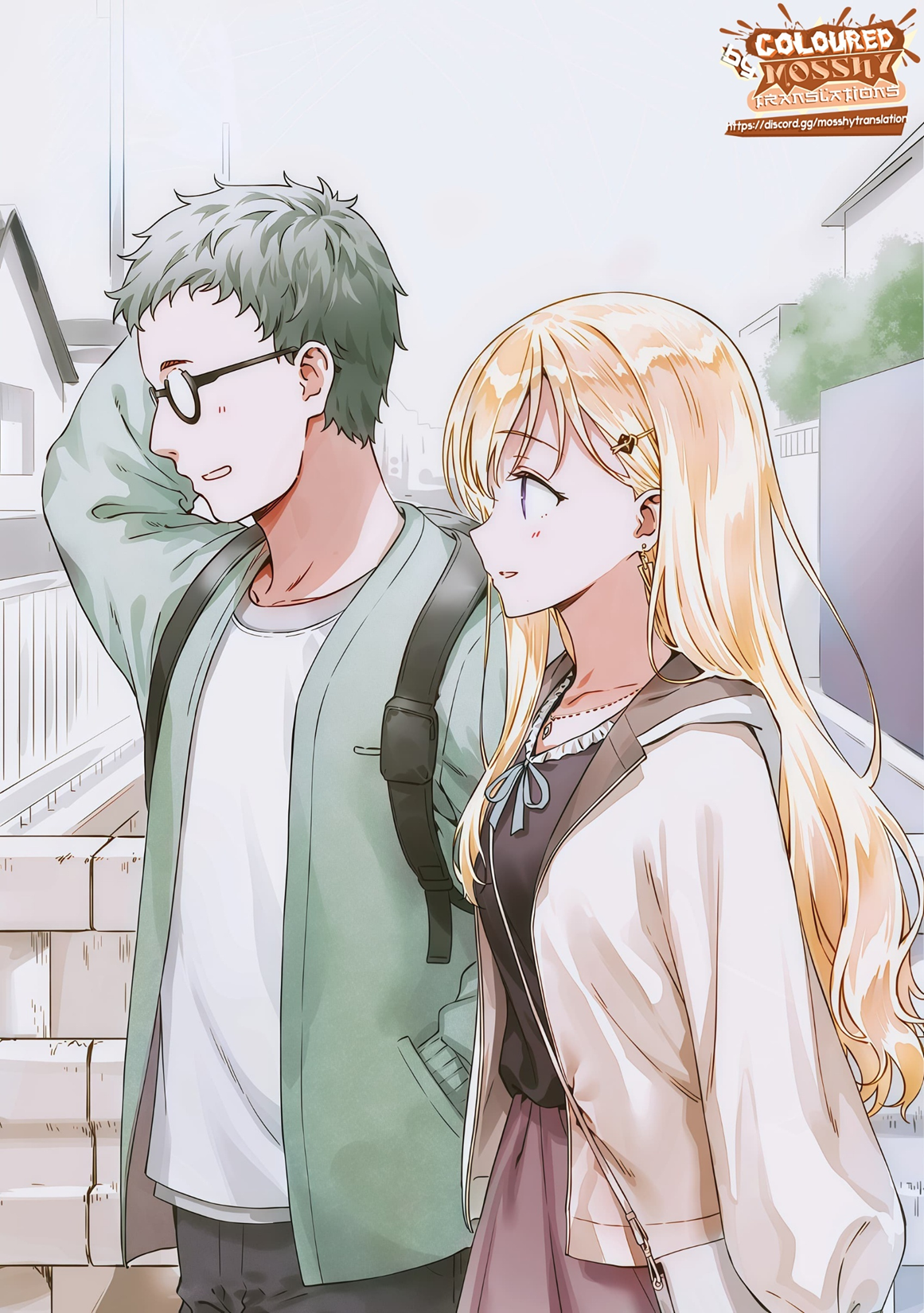
“I think we should leave our luggage in a locker,” I suggested.
“I agree. It’s always better to be light on your feet when touring museums,” Ayase-san replied.
Since it was our last day, we had already checked out of the hotel and were carrying all our luggage. The morning walk had been leisurely, but the afternoon would be tiring. The aquarium would likely be dimly lit, making our footing uncertain, and I didn’t want to be dragging a large bag around.
“The aquarium probably has lockers, but it seems like a bit of a walk from here,” I noted. “Just in case they’re full, I’d rather leave our stuff here.” Ayase-san seemed convinced.
We found some lockers just past the ticket gates and stowed our travel bags, keeping our valuables with us.
“The aquarium is on the north side of the station, I think it’s this way,” I said, consulting the map app on my phone. A sign on the wall confirmed we were on the right path, and I breathed a sigh of relief.
“Asamura-kun, you don’t get lost, huh~” Narasaka-san commented.
“Well, I am looking at a map…”
“You know, there are people in this world who get lost even while looking at a map,” she said thoughtfully. “And it’s always those people who walk with such confidence. They lead everyone on, and just when you think they know the way, they’ll ask, ‘So, where are we going again?’ I’m talking about my dad, by the way!” she added, calling it her family’s weak point.
“As far as the map shows, we just go straight and then turn left once. I don’t think we can get lost.”
As I led the way, I took in the scenery. The sky felt wider here than in Shibuya, and the sidewalks were spacious. It was almost 2 p.m., and there weren’t many people around. We had planned our trip to avoid the spring break crowds, so it was a relief to see it wasn’t packed.
“Oh, look!” Narasaka-san shouted, pointing down the street. “A Ferris wheel! It’s huge!”
I had noticed a tall structure looming in the distance. As we got closer, I could see it was a Ferris wheel viewed from the side, which was why it had looked like a single, slender rod.
“According to the map, that’s the Tempozan Giant Ferris Wheel,” I said.
“Hmm. It seems to be one of the world’s largest, with a diameter of 100 meters and standing at 112.5 meters tall,” Ayase-san read from her phone.
“Wow, one of the world’s largest!”
“No,” Maru said flatly.
“Wha! I haven’t said anything yet!?” Narasaka-san protested.
“You want to ride it, don’t you?”
She gave a series of rapid nods like a small animal.
“If we ride it, we won’t have time for the aquarium.”
“Uuuuugh.”
“Be patient.”
“Ugh, okay…”
“I get why you’d be drawn to the words ‘world’s largest,’ Maaya,” Ayase-san said sympathetically. “If we had time, I might have wanted to ride it too.”
“Apparently, some of the cars have transparent floors,” Maru added.
My heart squeezed tight at the thought. That’s too scary.
But Narasaka-san and Ayase-san’s eyes lit up. Thrill-ride enthusiasts were something else.
“But we have to pass this time,” Maru said, looking at me. Was he being considerate because the aquarium was my suggestion? Narasaka-san and Ayase-san nodded, though they still looked regretful.
When we were close enough to have to crane our necks to see the Ferris wheel, we reached a wide intersection. A quick glance at the map confirmed that after crossing the street and turning left, the aquarium would be right there.
“A giraffe,” Ayase-san said suddenly. I looked up from my phone. A giraffe?
It wasn’t a real one, but a giant sculpture made of toy blocks, standing at the corner of the street. Why is there a toy giraffe here?
I checked the map again. “Aha, so that’s it. There’s a toy block theme park near here, too.”
“Eh, really!?”
“Narasaka,” Maru warned.
“I know, I know. You’ve put up with our hobbies all this time. We’re going to the aquarium, I promise.” The weight of expectation for the aquarium suddenly felt heavy. “I was just thinking that my brothers would be happy,” she added. Maru suggested she could bring them next time, to which she complained that she couldn’t handle them all on her own. She was a good big sister, always thinking about her brothers.
After walking for about five more minutes, our destination came into view. “That looks like the aquarium,” I said, closing the map app.
We lined up at the ticket counter. It was busier than I expected, but the line moved quickly.
“The main attraction here is the permanent exhibition that uses several large tanks,” I explained, sharing the information I’d researched beforehand. “The concept is ‘Recreating the Pacific Rim Ecosystem.’ Each tank reproduces the environment of a different place in the Pacific.”
“Various places in the Pacific?” Ayase-san asked.
“Yeah, like Japan, the Aleutian Islands, Monterey Bay, Panama Bay… it’s like a tour around the ocean.”
“A-leu-tian Is-lands,” Narasaka-san sounded out the unfamiliar name. Wasn’t she supposed to be the one that passed the entrance exam for Japan’s most difficult national university?
“No, I know! Um, between Alaska and the Kamchatka Peninsula!” she quickly recovered.
“Panama Bay is where the Panama Canal is, right?” Maru asked.
“It’s at the Pacific side entrance,” I confirmed.
“So that means it’s almost at the equator. Around 8 to 9 degrees north latitude,” Maru said, having already looked it up on his phone. He also found Monterey Bay, which was on the coast of California.
“Oh, there’s an Antarctic one too! Penguins, polar bears!” Narasaka-san said happily.
“Ah, that’s a common misconception,” I corrected her gently. “Polar bears aren’t in the Antarctic.”
Her eyes went blank. It wasn’t a slip of the tongue; she really didn’t know.
“Polar bears live in the Arctic Circle, the northern part of Earth. Conversely, penguins are from the Southern Hemisphere, so the two species never live together in the wild. Also, there are many types of penguins, and not all of them live in cold places.”
“Huh.”
“I didn’t know that. You know a lot, Asamura-kun,” Ayase-san said.
I felt a little bashful. “It’s nothing.”
“Well then, shall we go in?”
We bought our tickets and headed inside.
It was a world of blue. Inside the aquarium, the lighting was dim, casting everything in shades of blue. It seemed the transparent tank panels themselves were colored.
“I wonder why it’s so blue,” Narasaka-san mused.
“Don’t fall, okay?” Maru said, walking behind her as she navigated the gentle slope.
“I’m fiiiine. I may be excited, but I’m not fooling around.”
He gave her a doubtful look, but she was probably telling the truth. Animals dislike loud noises, so tapping on the glass was strictly forbidden. Conversations naturally dropped to a whisper. Narasaka-san’s tone was the same, but her volume was properly subdued.
“She’s being pampered,” Ayase-san muttered under her breath. Since she was usually the one taking care of others, she was enjoying being pampered by the person who was taking care of her.
“Hey, Asamura-kun,” she whispered. “Maaya just asked, but why is it so blue in here? Because it’s the sea?”
Um, where do I begin?
“The largest tank here, the Pacific Ocean Tank, is nine meters deep. Sunlight travels different distances through water depending on the color. Red light gets absorbed quickly, disappearing almost completely within a depth of ten meters.”
Ayase-san’s eyes widened. “You just said this tank is nine meters deep.”
“Right. So almost no red light reaches the bottom. Blue light, on the other hand, can reach depths of over 100 meters. So, the sea at this depth is filled with the color blue.”
“Heeh… I guess this is what the world looks like to the fish…”
“The bottom of the sea is a blue world…”
“And this is still considered shallow. Deeper than 200 meters is the ‘deep sea,’ where no light reaches at all. It’s a world of complete darkness.”
“You know a lot. How do you remember all this?”
“Do I? It’s not something I learned studying for exams. Come to think of it, you mentioned I used to have tropical fish. Maybe I learned it then?” I wondered aloud. I had done some research beforehand, but a lot of this knowledge was pulled from somewhere in the back of my mind. “Ah, I remember now. When I was a kid, I liked looking at picture books.” Not just animals, but space and vehicle encyclopedias, too. My dad had a lot of them, and I would spend hours poring over them.
“When you’re a kid, you want to show off what you’ve learned, right?”
“Is that how it is?”
“I was that type of kid, always spouting trivia from encyclopedias.” I was a precocious child, and my parents encouraged my curiosity. I’d proudly announce things like, “Whales are mammals, not fish!” or “A light-year is a unit of distance, not time!” It’s embarrassing to think about now. “But talking about something helps you remember it. The trivia I learned back then is still stuck in my head.”
My parents must have patiently listened to all my little lectures. The people I was showing off to were my father and my mother. ‘You know so much, Yuuta. Teach Mommy, too,’ my mother would say with a smile. This was before I entered elementary school, when the atmosphere at home was still good. Being praised by my smiling mother made me genuinely happy.
That desire for knowledge faded after I failed my elementary and junior high entrance exams, and completely vanished after my mother left. There was no one to praise me anymore. Worried about me spending all my time cooped up at home, my father started taking me to zoos and museums. Around the same time, I started reading again, and slowly, like water seeping into dry sand, my curiosity returned.
“So, you see, the knowledge involving detailed numbers, like how water pressure increases, I probably learned much later. I don’t even remember where anymore.”
“I see.”
Just then, Narasaka-san and Maru came back from ahead.
“Hey. There’s a big one in the big tank.”
“It’s amazing!” Maru added.
You two aren’t conveying anything with that.
But I had a hunch what they were talking about.
“Ayase-san, let’s go. It’s probably the main attraction. The one they said we could see if we came here.”
“It’s some kind of shark, right? A whale shark?” she recalled.
“Yeah, that’s it. I’ve heard it’s big, but this is my first time seeing one, too.”
The tank they were talking about was the star of the aquarium, the Pacific Ocean Tank. It was installed in the center of the building, and the visitor path spiraled down around it, offering multiple views. At nine meters deep and thirty-four meters wide, it was about half the size of a school building.
“So, what’s this big one?” I asked.
Maru pointed diagonally up and to the right. “That’s it. It’s coming this way now.”
I followed his gaze and let out an involuntary “Whoa.”
“That’s… a whale shark?” Ayase-san murmured, her voice dazed.
A giant fish, at least four or five meters long, was slowly swimming toward us. Its overall shape was that of a shark, but instead of a pointed nose, it had a flat, wide face and mouth.
“As expected of the world’s largest fish,” Maru said in awe.
“It looks like it could swallow you whole…” Ayase-san whispered.
This was my chance to show off my research. “Do you know what whale sharks eat?”
“Um… since it’s so big, maybe other big fish?” she guessed.
“Plankton,” I revealed.
“Huh? But plankton are tiny.”
“Right. Their main diet is extremely small creatures. Apparently, they have to eat about eight kilograms a day.”
“Eight…!”
“They open that big mouth and suck in seawater, filtering out the plankton. Despite their size, they’re gentle and don’t attack humans.” The fish did have a somewhat vacant look on its face. It was big and strong, but its temperament was gentle, and its movements were leisurely as it swam from the bottom of the tank to the top and back down again.
“Even though it’s so big… it’s gentle…”
“Whale sharks are ovoviviparous, meaning the eggs hatch inside the mother’s body. About 300 are born at a time, but since they aren’t raised by their parents, it’s said that only a few survive.”
“They’re not raised?”
“Right. It’s what you call high birth rate, high mortality rate. You see it a lot in fish and insects.”
“Are all fish like that?”
“Actually, that’s something I was curious about, too,” I admitted. Perhaps our shared experience of being abandoned by a parent was why the question resonated with us. “But I found a site that explained it depends on your definition of ‘child-rearing.’ In a broad sense, child-rearing is ‘increasing the survival probability of one’s children.’”
Seeing her nod, I continued. “Most fish scatter their eggs in the water, and the current carries them away. But with ovoviviparous species, the eggs are protected inside the mother’s body until they hatch. In that sense, you could consider that a form of child-rearing.”
“Ah, I see. So it’s 300 after being raised to be more likely to survive.”
“Exactly. Though it’s still considered a high birth rate, high mortality rate.”
“Only a few survive…”
“But when you think about it, that might be natural. As long as two offspring survive to produce the next generation, the species won’t die out. And since the oceans aren’t filled with whale sharks, you could say that this is the only way for their species to survive.”
“So… it’s hard for them to survive?”
“They probably don’t get eaten after they grow this big, but they don’t have any other survival strategies. They can’t attack, they’re not poisonous, and they can’t swim fast.”
“They have no way to protect themselves other than growing big…”
“That’s right.”
“Even though it’s a shark.”
“So, I think it’s a big deal for them to become this size. They’ve really fought to survive,” I muttered, watching the whale shark approach again.
“But they can live a long time once they get this big, right?”
Their lifespan is about 100 years, not so different from humans. When I told Ayase-san that, she seemed to feel a renewed sense of kinship with the creature.
“In that sense, humans are also born after growing inside the womb, so child-rearing in a broad sense starts before birth, doesn’t it?”
I was taken aback. I’d never thought of it that way.
“Wait. If whale sharks had a longer child-rearing period, could they survive even if they were born in smaller numbers?” she wondered.
“You mean if they were raised to be even bigger inside the womb?”
“Yeah. For example, if they were born ten times the size, would they only need to have one-tenth the number?”
“I don’t think it’s that simple… but in a broad sense, that might be true.”
“But even one-tenth is 30… That seems tough to give birth to. It’s like having triplets ten times, Asamura-kun…”
Isn’t her train of thought going off the rails again?
“No, in this case, we’re talking about the number for a single birth, so you can’t divide it by ten,” I replied, far too seriously.
“Thirty-tuplets! That’s just not possible.”
“Eh?”
“Children. I can’t give birth to that many. At least make it triplets! In installments! If you do that, I’ll do something about it for you.”
“You’ll… do something about it for me?”
“Eh?”
“Eh.”
“Ah, um… Not that part, I was hoping you’d react to the installments part…” she mumbled, flustered.
Ah, she was waiting for a comeback. “Was that an imitation of what Narasaka-san did yesterday?”
“Ah, um… yes.”
I glanced around. Maru and Narasaka-san were a little ways off, looking at a giant stingray. Good, I was the only one who heard that.
“Oh, dear. Was that actually a pretty embarrassing joke?” In the blue light, Ayase-san’s cheeks turned red, though it looked more like she was pale, which worried me.
“Um… This isn’t a loan repayment, you know,” I managed, but my delivery was completely monotone.
“…Forget it.”
“…Understood.”
My girlfriend had just said she’d handle triplets for me; how could my heart not clench? Ayase-san’s first-ever attempt at a joke, imitating Narasaka-san, had sunk without a trace, partly due to my own inexperience as her straight man. I felt truly sorry. Everyone has their strengths and weaknesses.
By the time we boarded the Shinkansen, the evening glow had faded, and the sky had turned black. We were all too wired to sleep, instead lamenting the end of our trip and sharing our favorite memories.
“Your guide at the Kaiyukan was good, Asamura-kun,” Narasaka-san said suddenly as the announcement for our arrival at Shinagawa came on.
“Why do you look so surprised?”
“Ah, no… I just didn’t feel like I was able to guide you well enough.”
“Well, true. The first half, you were just flirting with Saki,” she teased.
“We were not,” Ayase-san immediately retorted, though I humbly accepted the criticism—not the flirting part, but the part about my guiding skills.
We had taken a break at a cafe inside the aquarium, one that sold themed treats like a “Spotted Garden Eel Dog” and a “Whale Shark Soft Serve.” While we were there, I reflected that since the aquarium was my choice, I should have done more to make sure the others weren’t bored. This trip was supposed to be our way of thanking Maru and Narasaka-san, after all. So, in the latter half, I tried to interject as much trivia as I could remember, and I’d been wondering how well it went over.
“It was fun, like touring a museum with an audio guide,” Narasaka-san assured me.
“I’m glad you felt that way,” I said, breathing a sigh of relief.
“We’re almost there,” Maru said.
Outside the window, the city lights of Tokyo glittered under the night sky. I felt a sense of relief seeing them. People often associate “hometown” with the countryside, but I felt it seeing the city lights. I guess I’m a city boy through and through.
I saw Ayase-san’s reflection in the window, her eyes moist as she stared at the lights.
“Saki, are you crying?” Narasaka-san asked from the seat behind her.
“I’m not crying.”
“Aww, there, there,” Narasaka-san said, pulling her into a hug and gently patting her head.
“I told you I’m not crying…”
“It’s okay, it’s okay.”
“Well, it was a good trip,” Maru murmured, looking out the window.
I nodded in agreement.
With Ayase-san’s head still buried in her chest, Narasaka-san said, “It’s not like this is our final farewell or anything.”
“I told you, I’m not crying,” Ayase-san insisted, her voice muffled.
“Okay, okay.”
“Jeez! …It’s fine for you and Maru-kun, Maaya. You’re going to the same university,” she said, sounding a little sulky.
Where there are meetings, there are also partings. I had a premonition that university life would be much busier than high school.
Slowly, Ayase-san pulled away from Narasaka-san.
“I guess the four of us won’t be getting together to do something like this anymore,” she said suddenly.
“You think so?”
“Probably. When we become adults, we’ll have less time for ourselves. I wish I had hung out with you more, Maaya…” Her words reminded me of the classroom just before graduation, of her looking around at all the empty desks.
“It’s not regret, but it just feels like a waste, somehow.”
“We can make up for that in no time! We’re still young. Hey, let’s do something together, the four of us,” Narasaka-san suggested.
Ayase-san gave her a skeptical look. “‘Something’? What are you planning?”
“Hmm. Oh, how about posting videos? The four of us. It’s popular.”
Even Maru looked at her like she was crazy. “The entertainment world isn’t that easy.”
“You don’t have to be so serious about it!”
“Narasaka, do you understand? Anything you put out into the world comes with a certain amount of responsibility. It’s not something you should do with an inside-joke mentality—”
“How about a channel where Maru-kun reveals his treasures?” Ayase-san suggested.
“I don’t have any treasures worth revealing. The greatest treasure I have is at most—”
Off-topic again.
The Shinkansen glided into the platform. “Hey, we have to get off,” I urged, and the conversation trailed off as we scrambled to gather our things.
As we walked down the platform, Narasaka-san and Maru were still muttering to each other.
“How about a couples’ YouTube channel that just streams Saki and Asamura-kun’s lovey-dovey life? I think it would be a hit.”
A chill ran down my spine. The idea was for the four of us, so why had it become just me and Ayase-san?
“It’s over, huh?”
I turned to see Ayase-san behind me, a look of fulfillment on her tired face.
We exited the Shinkansen gates and went our separate ways. Ayase-san and I headed toward the Shibuya line, and as we walked our usual route home from the station, we talked about the trip.
—Well, it was a good trip.
Maru’s words echoed in my mind. I think so too, Maru.
The graduation trip ended, and with it, our high school life as the four of us came to a close.