● Freshman Year, July – Asamura Yuuta
July arrived with a suffocating heat, each day striving to outdo the last in a relentless climb of record-breaking temperatures. Days rarely dipped below thirty degrees Celsius, nights offered no escape from the tropical humidity, and every afternoon came with a heatstroke warning. Amidst this sweltering season, I found myself juggling university lectures and my part-time job at the bookstore with trips to a driving school. If all went well, I was on track to get my license by the middle of the month.
“You’ll have to give me a ride during summer break, okay?” Saki had said. The passenger seat has the highest death rate, though… I felt I lacked both the skill and the mental fortitude to confidently place her there.
Still, this new challenge was more invigorating than it was difficult. It made me realize that up until high school, I’d mostly been passively dealing with whatever came my way. This feeling of forward momentum, of actively moving myself—it must be what my friend Maru felt when he poured everything he had into baseball.
Though, when I’m confronted with a lack of progress, my mood tends to do a complete one-eighty.
On my way home after passing my learner’s permit test, I watched a massive cumulonimbus cloud drift lazily across the blue sky. It had a peculiar shape, as if someone had taken a single bite out of the right side of a piece of white cotton candy.
As I walked along the asphalt toward the bus stop, lost in this idle thought, my phone buzzed. The ringtone, a robotic dial tone, meant it was Maru. An irrelevant detail, perhaps, but the ringtone is not to my taste. I need that to be clear. Maru was just annoyingly persistent about it.
The caller isn’t even supposed to hear their own assigned ringtone. “It gets me pumped just imagining it,” he’d said. I didn’t get it. But, having no real reason to refuse, I’d set it as he asked.
“Yeah, yeah. I’m getting it now, hold on,” I muttered to no one in particular as I tapped the call icon.
“Let’s play baseball!”
“…”
“Hm? What’s wrong, Asamura? Hello? Can you hear me?”
“I can hear you. I was just wondering since when my friend reverted to an elementary schooler from a Sunday morning family anime.”
“What are you talking about?”
I think that’s my line. No matter how much of a jock I knew Maru was, he had to have some idea of what it’s like for a university student’s first words on a call to be, “Let’s play baseball!”
“I’d appreciate it if you could start from the beginning.”
“Hmm. It’ll take a while if I go in order, but…”
“As long as you don’t start from the creation of the universe, I’ll listen patiently.”
“A senpai from my club invited me.”
Right. Concise and easy to understand. Super short.
In high school, Maru had been in the baseball club, seriously aiming for the national tournament at Koshien. But reality is a harsh thing, and dreams don’t always come true just because you wish for them. Koshien remained out of reach, no pro or semi-pro teams scouted him, and by the time he got to university, he’d started boasting, “Now I can devote myself to my otaku activities.” I’d heard he joined an otaku-type club, but…
Could it be a new genre? A sports-type otaku club? I mean, esports players are definitely full-fledged athletes in my book.
“There’s a club alumni who’s on a sandlot baseball team.”
“Ah, I see.”
“He invited me to play in their game next Sunday. So, I told him I’d participate if I could bring a friend along.”
“And that’s why you said ‘Let’s play baseball’… Wait! That friend, could it be…”
“I made sure to advertise that his name is Asamura Yuuta.”
“I didn’t need that kind of advertising!”
“Why not!?”
His genuine shock didn’t help.
“Don’t you think it’s a bit of a high bar for a guy who’s never even properly played catch to be thrown into a game?”
“It’s true that as long as it’s a game, we should pursue victory. It’s not impossible that you, Asamura, might drop a routine fly ball with two outs and the bases loaded, turning it into a bases-clearing double. If we prioritize winning, then perhaps I shouldn’t have invited you.”
I would have preferred he didn’t conjure such a vivid, worst-case scenario.
“But ever since we faced off in the ball game tournament, I’ve wanted to team up with you in the same sport someday.”
“Why me?” I had to ask.
Maru’s voice sounded genuinely surprised. “Because it sounds interesting. Remember what she said when we were planning the graduation trip? ‘It’s not about where you have fun. The important thing is who you have fun with’ ”
She—he meant Narasaka-san. Come to think of it, I do recall her saying something along those lines.
“Asamura. The objective of a match is to win, but I wasn’t competing because I wanted to win—it’s a line I like, arranged my own way.”
The source was probably a manga or an anime, I figured. To Maru, being invited by a university senpai to play sandlot baseball was no different from his time in the high school club.
“If your motivation is to win, it’s not interesting even if you do, right? ’Cause your motivation is just to win.”
“You’re not happy when you win?”
“No, no, I’m happy. If we win, it’s a huge celebration. Whether you’re a regular or a backup, a manager or a coach, everyone gives their all for that one victory. The players on the field carry the feelings of so many people. There’s no way I wouldn’t be happy.” He took a breath before continuing. “I said it’s not interesting.”
“Not interesting…?”
“A game, Asamura, is premised on being repeated. Something that ends after one time is not a game. If it ends after one time, then winning justifies everything. In that case, you could ignore the rules, and fair play would just be a hindrance.”
I mulled over his words. It was true. If you were playing a game you’d only ever play once, the logic of ‘to the victor go the spoils’ held up. In exchange, your opponent would probably never play with you again.
“That kind of thing is called a duel. The score is settled when one of you dies. But if people were dying left and right, it wouldn’t work as a business.”
“W-Well, that’s true.” It was a bit extreme, but I could see his logic.
“That’s why even if the objective is to win, your motivation shouldn’t be to win. Such a motivation isn’t fitting for a game. Well, this is just my opinion, though.”
It felt like he was saying something profound, yet at the same time, I felt like I was being tricked somehow.
“And also,” Maru’s tone shifted, and I could practically hear him grinning on the other end of the line. “The biggest reason I want you on the team is because we might not have nine people on the day of.”
“Wait.”
“She’s close to giving birth.”
A pregnant team member!?
“And apparently, it’s Marie-chan’s first time.”
“Marie-chan?” A foreigner?
“The mother toy poodle. Marie-chan. She’s the Suzuki family’s beloved daughter.”
“Oi.”
“I hear they dote on her so much it wouldn’t hurt to put her in their eye. Pets are family these days, you know. Can’t neglect them. Besides her, there’s Yama-san who has a bad back and can’t play on days it hurts, and Kurumi-san who can’t come because of her kid’s class observation day.”
“I’m surprised that team is even functioning.”
“That’s why we’re constantly looking for backups.”
And I was the backup of choice.
“He says he’s willing to promise you a spot as a regular right now.”
“That’s too much pressure!”
Still—
The reason I ended up saying, “I guess I can go,” while adding the disclaimer, “Don’t expect much from me,” was probably because I’d been thinking I needed to be a bit more proactive lately.
Choosing to do something with someone is rare for me; I’ve always preferred to go solo. A person’s fundamental nature doesn’t change so easily, but I’ve recently come to believe that if you don’t reach out and take the hand of someone you don’t want to lose, that connection will simply fade away.
On the other end of the phone, Maru’s cheerful voice saying, “You’re a lifesaver,” echoed in my ear, and I felt the oppressive weight of the summer heat lift, if only just a little.
Three days later, I was in the middle of on-road training.
About a hundred meters ahead, the lane I was in simply ceased to exist.
There are legally required lengths for acceleration lanes when merging onto highways, determined by the design speed of the main road. The highway I was about to enter had a speed limit of 80 km/h, meaning the acceleration lane was between 150 and 200 meters long. For a car at that speed, it’s a distance you cover in less than ten seconds.
Ahead, two lanes became one. On the main road, a steady stream of cars flowed past at 80 km/h. Glancing over, the speed felt immense, and the thought of cutting into that flow was terrifying.
“Step on the accelerator a little more!” a voice called out from the instructor’s seat beside me.
I pressed the pedal with my right foot as instructed, and the car lurched forward. The merge point was rapidly approaching.
“More, more. Step on it.”
At his cue, I pushed down harder, increasing our speed. The vibrations from the tires gripping the asphalt traveled up through my body, intensifying with their rotation.
“Right turn signal, check your mirror.”
I flicked the lever on the right side of the steering wheel. The signal began to blink.
“You can get in behind that red car coming up.”
The bright red car he indicated shot past, seeming to graze our side as it moved ahead. The instructor’s command came out sharp, as if telling me to tailgate it.
“Now! Accelerate!”
“Y-Yes!”
I stomped on the accelerator. The training car’s nose slid from the acceleration lane into the main one at the last possible second, chasing the tail of the red car. Were gonna crash! My blood ran cold, but my speed was still far below the highway’s flow, and the red car was already pulling away. I let out a breath I didn’t realize I was holding. That was close.
“Don’t let your guard down. Come on, keep accelerating.”
The next car was already closing in from behind. I kept my foot on the pedal, and gradually, the training car matched the speed of the other vehicles. As our speeds aligned, I was finally able to maintain a proper following distance.
“Good. Maintain that speed.”
“Yes.”
My hands, gripping the steering wheel, were slick with sweat. My heart was still pounding, and a cold sweat broke out as I replayed the merge in my mind. It seemed I had successfully entered the highway. But—
“S-Sorry for being so hesitant.”
In response to my apology, the instructor’s tense voice softened. “Not at all,” he encouraged me. “Hesitating to accelerate on the highway is very common at first. It’s okay, it’s okay.”
“Yes.” Relieved to have a kind instructor, I braced myself again.
Before I started my lessons, the word “instructor” had a scary ring to it. But these days, driving schools are businesses, and it’s well understood that students are customers. It seems common sense now to treat them as such. Thanks to that, they were patient with my mistakes and always spoke politely.
“We’ll maintain 80 km/h for now.”
“Y-Yes!”
Glancing at the speedometer, I focused on keeping the needle hovering around 80. A slight press on the accelerator sent it over, while easing off caused the car behind me to close in quickly. In fact, even though I was holding steady at the legal limit, the car behind me seemed to be getting closer…
“Don’t panic. The speed limit on this road is 80 km/h. You’re not in the wrong. Of course,” he added, “the reality is that just because you’re not wrong doesn’t mean things like this won’t happen.”
I realized he was right. If everyone followed the rules perfectly, governance would be unnecessary. In the real world, a certain margin for error is unavoidable. Whether that’s good or bad is another story.
“For now, let’s just head to the next service area. Hang in there.”
“Y-Yes.”
I had absolutely no mental capacity to appreciate the scenery whizzing by; I was at my limit just monitoring my surroundings and maintaining speed. My mind was a whirlwind of sighs.
After pulling into the next service area and parking, I finally felt calm enough to speak with the instructor.
“Yeah,” he began. “You’re completely fine driving on the highway. That was good. For now, it seems what you struggle with is merging. We might need a little more practice with that.”
“…Yes.”
“A tip for merging, Asamura-san. Think of it not as ‘having them let you in,’ but as ‘going in.’”
“‘Going in’… you say?”
“Yes. It might not have clicked with just the classroom lectures.”
“‘Having them let you in’ and… ‘going in.’ What’s the difference?”
“Hmm,” the instructor pondered, stroking his chin. Then, in a calm voice, as if explaining to a child, he said, “Let’s see. I suppose it’s the difference in how much you outwardly express your intentions.”
My clueless expression must have told him I still didn’t get it, because he elaborated.
“Basically, if you just wait around passively, no one knows what you want to do. People can’t read minds, you see. If you, Asamura-san, don’t show your intentions more clearly, the drivers trying to make space for you will just get confused. They have no idea what kind of driver you are or when you intend to enter.”
His words hit me hard. If I don’t show my intentions first, the other person won’t know…
“By showing your intention to get on the highway, the people around you can finally gauge the timing and react. That’s how it works.”
“I… see. I think I kind of get it.”
In other words, he was saying I was good at adjusting to my surroundings but bad at making my surroundings adjust to me. I was bad at being assertive. I was well aware of that. I’m not the type to push my own way. However, that should be different from not asserting myself at all.
“Mind you, even if you clearly show you want to merge, Asamura-san, some drivers will stubbornly refuse to let you in.”
“They will?”
“The other person has their own reasons. It’s not something you can blame them for. But whether they accept you or reject you, that all comes after you first express your intentions. If you don’t express them, nothing gets across.”
Still, he encouraged me, saying I was doing well aside from merging. “Once you get used to it, you’ll be able to do it too, Asamura-san.”
I wonder if that’s true? Somehow, I couldn’t imagine a day when I’d be able to do it so easily.
“It’s okay, it’s okay. Well then, shall we head back for today?”
We left the service area and got off the highway, taking regular roads back. The scenery flew past the car window. As long as I was just driving like this, maintaining distance between cars, it wasn’t too much of a strain.
Up until the on-road training, from the classroom lectures to driving on the enclosed course, things had been going relatively smoothly. But the moment I hit the real road, everything changed.
As we were parting ways after the lesson, the instructor suddenly spoke up.
“Asamura-san, do you know the saying, ‘A hundred thoughts are no match for a single action’?”
I was about to say yes, but I stopped myself. “‘A single action’? …Not ‘A hundred hearings are no match for a single sight’?”
“That one’s well known, isn’t it? It means it’s easier to understand if you see it. The saying I mentioned is a teaching that says, ‘Instead of just thinking about it, it’s important to just try doing it.’”
Instead of just thinking about it…
I felt that familiar tension in my gut, the one that comes when someone hits the nail on the head.
“That’s what I mean when I say you’ll get it with practice. I think what you’re lacking, Asamura-san, is real experience. Embodying it, you could say. Or to use a popular term, ‘physicality.’”
“‘Physicality.’ The idea that actions and thoughts are established through the body, right?”
“Yes, that’s it. Virtual experiences are popular, but I believe there’s knowledge that can only be accumulated by moving your body.”
Thinking back on how the driving maneuvers that went so well on the simulator were completely useless on the real road, his words felt incredibly reasonable. I was powerfully reminded of the vast gap between virtual and reality. Reality is far more diverse and complex.
“Maybe you should value physicality a bit more, Asamura-san. First, let’s keep challenging this on-road training. You can do it!”
While I was happy for the encouragement, I felt a little down. I didn’t think I was wrong to read books to broaden my perspective, but I was being confronted with the fact that, that alone wasn’t enough.
On the way home, from the window of the Yamanote Line, I caught a glimpse of the lit-up Shuto Expressway.
Driving there with Saki beside me.
Is such a thing even possible?
Even though summer break was just around the corner, my promise to take Saki for a drive felt more distant than ever.
The expressway vanished from view as the train pulled away from Shinjuku, heading towards the familiar station in Shibuya.
Once July arrived and the rainy season ended, the sunlight became more violent.
It’s Saturday, the weekend. Early in the morning, Saki and I are on a train, swaying as we head towards Shakujii Park.
Today is the day of my promise with Maru. The sandlot baseball game.
The meeting time is an early 8 a.m., partly because the field is only available from 9, but also because playing sports outdoors in the Kanto region in July is nearly impossible due to the risk of heatstroke.
Saki, looking at her phone, informed me the expected high for 2 p.m. was 27°C.
“It’s hot…”
“But it seems better than tomorrow. They say tomorrow’s high is 31°C.”
I grimaced, leaning against a handrail. If I recall correctly, once the heat index goes above 25°C, the risk changes from “caution” to “alert.”
“Baseball fields don’t have shade, do they?”
“I wonder. The place we went to cheer for Maru-kun last year barely had any.”
“Thought so.”
“I brought a water bottle, just in case,” Saki said, lightly tapping the sports bag on her shoulder.
“What’s inside?”
“Sports drink. And a bento, too.”
“Nice. Also, sorry for leaving it all to you.”
“It’s fine. You had a lot to prepare too, right? You’re not forgetting anything?”
I nodded. I had, in fact, acquired some baseball equipment for the occasion. After asking Maru what I needed, I found a small sports shop in Shibuya. The selection wasn’t great, but the staff was kind. When I told them my purpose, they recommended a glove, a rubber-ball, and spikes, saying it would be more than enough. I took the professional’s advice and bought everything they suggested. Maru had offered to lend me gear, and it seemed wasteful to buy a full set only for it to gather dust in a corner of my room.
I was told to wear comfortable clothes I didn’t mind getting dirty, so I just stuffed the jersey I used for P.E. in high school into my bag. My preparations were carefree, to say the least, and now, on the train, anxiety began to set in.
“Maybe I should have at least played some catch in a nearby park.”
“But you need a partner for that, right?”
“Well, yeah,” I said, glancing at her.
She shook her head vigorously. A clear no. “No way, no way. The ball is way too hard and small.”
“Small…?”
“I’ve held a softball before. During P.E.”
“Ah.” That made sense. The softballs used in P.E. are large and soft. A baseball, by contrast, is smaller and harder. The night I bought my equipment, I’d put on the glove in my room and tossed the ball up to the ceiling, a test even more basic than playing catch. Even then, I could feel how hard it was. And this was just a rubber-ball; Maru and the others in his club used an even harder official ball. When I asked him, “Doesn’t it hurt your hands?” he’d just replied, “It does. It’s fine. You get used to it.”
When I told Saki that story, she’d muttered, “athletes are amazing, huh.”
I felt the same. The fact that they could practice until they got used to the pain was unbelievable. But then, it’s different for things you’re passionate about. For someone who doesn’t read, my habit of reading every day probably seems just as amazing.
“That might be true,” Saki nodded in agreement. “I always thought it was amazing how you read books every day, Yuuta.”
“Well, I guess I’m worried that I don’t have that level of passion for this,” I admitted. “On top of being inexperienced, it’s a team sport with a bunch of strangers. Sandlot baseball is a bundle of things I’m bad at.”
“Even so, we’re already here, you know?”
“Yeah, you’re right.”
We got off at Shakujii-kōen Station and met Maru at the designated spot. A little later, Narasaka-san arrived. Both girls were holding parasols against the sun.
“So, we just wait here?”
“Yeah. I think the captain will be here soon, so I’ll introduce you.”
The “captain” was, apparently, the captain of the “Raimei Sisters.” It was only then that I learned the team’s name.
“Raimei Sisters… Sisters?” The name suggested an all-female team, which couldn’t be right, since Maru was on it.
“It’s ’cause the captain likes little sister characters.”
“Little sister… characters?” As in, the moe archetypes from light novels?
“Ah, did I not mention it? You know ‘Raimei’ too, right, Asamura?” Maru asked.
“Raimei?” I was confused, and my confusion only grew when Narasaka-san cheerfully raised her hand and said, “I know it!” while pointing at the baseball cap she wore. Specifically, she was pointing to a large pin on it, which featured the face of a cute, short-haired girl.
The art looked vaguely familiar…
“The only reason you know about it is ’cause I told you it,” Maru retorted.
Narasaka-san glared at him. “Tomo-kun?” she said, her voice dropping.
Maru’s face went pale. “You?”
“Ah, no, um… well.”
“Well?”
“Well, well, it’s nice weather today, huh.”
“It’s so sunny I need sunscreen. It’s not just ‘nice, nice’ weather!”
“I’d like to talk about ‘Raimei,’ though,” I interjected, trying to steer the conversation back.
“I want to too, Tomo-kun. Hey, Tomo-kun. We made a promise, Tomo-kun!”
“Well… bu—”
“Yes!” A beaming smile rained down on Maru along with the unforgiving sunlight.
Leaving my best friend to hang his head under the weight of his girlfriend’s cheerful wrath, I finally placed the character on the pin. “Oh, the little sister of Rai, the protagonist of ‘Raimei’.”
“Yes, yes, yes! As expected of you, Asamura-kun, you’re so knowledgeable!” Narasaka-san beamed.
“Maru recommended it to me a long time ago. I remember it being pretty quirky and interesting.”
The character, Mei, was from the manga ‘Raimei.’ The author was a perfectionist, so the series had been on hiatus for a while after the fourth volume. It was a battle manga where a brother and sister with lightning-based superpowers fought enemies—the brother used light magic, the sister sound magic. If it had stopped there, I wouldn’t have been that interested. But it had delved into strange, elaborate concepts like “the universe was actually made of sound and light” and “a cosmic entity that destroys dimensions,” which had hooked a niche group of enthusiasts, including me. And above all, the protagonist’s little sister was reputed to be incredibly cute, a fact that had clearly captured Maru’s heart.
“I know, right? Mei-chan. She’s so cute, isn’t she?” Narasaka-san said, stroking the button on her hat.
“Is that so?” Saki, the only one who hadn’t read it, tilted her head.
“It is! Mei-chan’s cuteness is the real deal. You should read it too, Saki. As a little sister yourself, you’ll be hooked!”
“I-Is that so?” Saki seemed a little taken aback by her intensity.
Well, I think a real little sister would be less likely to get into little sister-themed stuff… but it seemed tactless to point that out.
“Well, she’s certainly cute,” I agreed. “Her regular art is, and her chibi art is cute too. And I think the author does a great job expressing sound magic in a manga format—”
As we were getting excited over a topic completely unrelated to baseball, a voice called out from behind us.
“I’m glad to hear you say that. Thank you.”
Surprised, I spun around. A man in his forties with a mustache was standing there, a smile on his lips. He was wearing a T-shirt with a large print of Mei-chan’s face on the chest, along with the ‘Raimei Sisters’ logo.
“Tori-san, good morning!” Maru greeted him.
“Hey. Maru-kun, good morning.”
The fact that Maru called him “Tori-san” meant he was likely from the team.
“This here’s today’s helper, Asamura,” Maru said, patting my shoulder. “Asamura, this is Tori-san, or rather, Torigoe-san.”
I bowed my head reflexively. “I’m Asamura. Um… Maru’s friend.”
“Yeah, I heard. Nice to have you today,” Torigoe-san said warmly. “I’m Torigoe, the captain of the ‘Raimei Sisters.’ I’m glad to hear you’re a fan of Mei-chan.”
“Ah, yes.” He must be a fan of ‘Raimei’ too, I thought.
But my simple assumption was overturned by Maru’s next words.
“Asamura, Torigoe-san is the editor in charge of Belladonna-sensei, the author of ‘Raimei.’”
Excuse me? Editor in… charge?
“Nice to meet you,” Torigoe-san said with another smile.
“Ah, yes. You’re welcome.” You’re welcome? What was I even saying? My confusion was mounting.
Ignoring my bewilderment, Maru began introducing me to the other team members as they arrived. By the time practice started, I was relieved that everyone seemed friendly and welcoming, but the initial mystery had only deepened.
Editor in charge… what does that mean?
There was no time to ask. Pre-game practice began, with everyone pairing off to play catch. Being my first time, I didn’t have a partner.
“I’ll be your partner, Asamura,” Maru said, slapping a ball into his glove. “You can at least play catch, right?”
“I’ve barely ever done it,” I confessed.
“Don’t be so nervous. We’re not focused on winning or losing here.”
He said that with a smile, but it was impossible for me not to be nervous. The situation—learning to throw, catch, and hit thirty minutes before a game—felt like a gross underestimation of sandlot baseball.
And reality was not so kind.
Most of that thirty minutes was spent just trying to catch the ball Maru threw. It looked like he was tossing it lightly, but it felt incredibly fast, and I couldn’t catch it at all. All I managed was to knock it down with my glove. My return throws were even worse, arcing high and flying off in completely wrong directions.
It was only natural. For eighteen years, I’d had no connection to the sport. I’d avoided team sports whenever possible. There was no way I could become proficient in thirty minutes.
When practice ended, it was game time.
I couldn’t even catch a simple fly ball in right field, and I flinched away from line drives. When I finally did manage to scoop up a rolling ball, my desperate throw back to the infield was so loopy that the runners advanced with ease. When they scored three points in the top of the first, I felt so bad I wanted to run away.
Sandlot baseball is too hard!
I trudged back to the bench, my legs feeling heavy. But to my surprise, no one—not the team, not Narasaka-san, not Saki—showed any disappointment. They greeted me with cheerful calls of “Don’t worry about it!” and “That was close!”
Ah, so this is what he meant. On this team, you weren’t judged by your results.
“Oi, Asamura. You’re up to bat.”
At Maru’s voice, I looked up from catching my breath on the bench. “Eh? I’m number eight, right?”
“You’re number eight, but you’ll also be batting for numbers two and five.”
“Excuse me?”
“Yoshida-san got a frozen shoulder yesterday and can’t swing a bat. And Daitokuji-san at number five says he doesn’t want to bat because it’s scary.”
“Wait. Is that even allowed?”
“Rejoice, your turn at bat will come around three times more than usual. Don’t worry if you strike out.”
Even for sandlot baseball, were such loose rules okay? What if I got on base? “Someone else will stand in the batter’s box then, so don’t worry about it,” Maru said.
“It’s like this for a practice game,” he assured me. “Both sides agreed on the special rules. So go ahead and strike out with peace of mind—I mean, swing the bat!” That was his way of encouraging me, assuming I wouldn’t even make contact.
When he put it that way, it made me want to at least try to hit the ball.
“Batter, out!”
…Three pitches, three strikes.
“So close, so close. Don’t worry about it,” Saki said, which somehow stung the most. Ugh… if my turn is going to come around that many times, I’ll hit it no matter what.
But things didn’t go so well. Two hours later, the game ended in a flashy 12-to-9 score typical of sandlot baseball, and I had a miserable zero hits.
“But in your last at-bat, I think you were almost there, Asamura-kun,” Torigoe-san said during the post-game reflection. It was true. Though I had no hits, my many turns at bat had allowed me to gradually get used to the speed. In my last at-bat, I’d finally made contact, sending a fly ball to left field for an out.
“I think you’ll get a hit next time. You’ve got good instincts, Asamura-kun.”
Though I suspected it was just flattery, it didn’t feel bad. As we parted ways, Torigoe-san gave me a business card, which finally confirmed he was indeed the editor in charge of Raimei.
“I’ll invite you again,” he said.
Later, Maru explained that the Raimei Sisters was a team originally created by Torigoe-san and Belladonna-sensei to help mangaka get some exercise and build industry connections. Belladonna-sensei, however, was so behind on the manuscript that all baseball activities were on hold. A shiver ran down my spine at the thought that I might have met the mangaka himself.
After the game, the four of us—me, Saki, Maru, and Narasaka-san—had a wrap-up party at a fast-food place near the station.
“Here, look, look, Asamura-kun!” Narasaka-san said, turning her phone screen towards me. It was a video of me in the batter’s box, looking like a complete amateur.
“Whoa, when did you record this?”
“I told you beforehand I was going to film, didn’t I?”
“…Did you?”
“I did, I did. Right, Tomo-kun?”
“Yeah, she did,” Maru confirmed.
“Well, honestly, I was too nervous to notice the details,” I admitted.
“Was it bad? Should I delete it?” Narasaka-san asked, looking disappointed.
I shook my head. “No, it’s fine. It’s just a little embarrassing. Seeing myself playing sports objectively is a strange feeling.”
“Eh? I think you look cool, though. Right, Saki?”
“Me now? …Well, I guess so.”
“What’s with you averting your eyes like that! You were filming him with a serious face the whole time too, Saki!”
“Ugh.”
Saki blatantly looked away for a moment before holding out her own phone, looking guilty. “Sorry, I was filming too. This one’s a photo, though.”
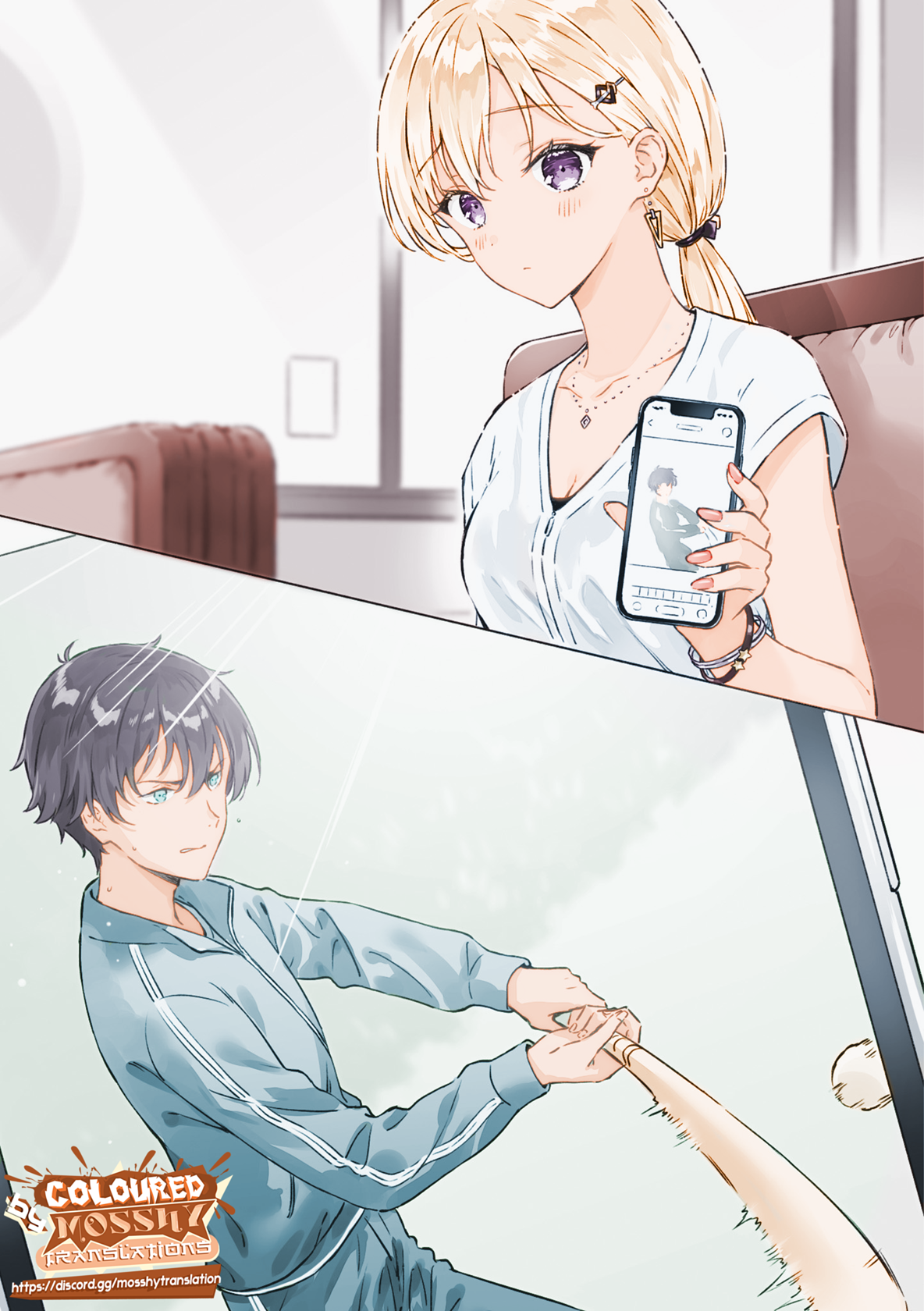
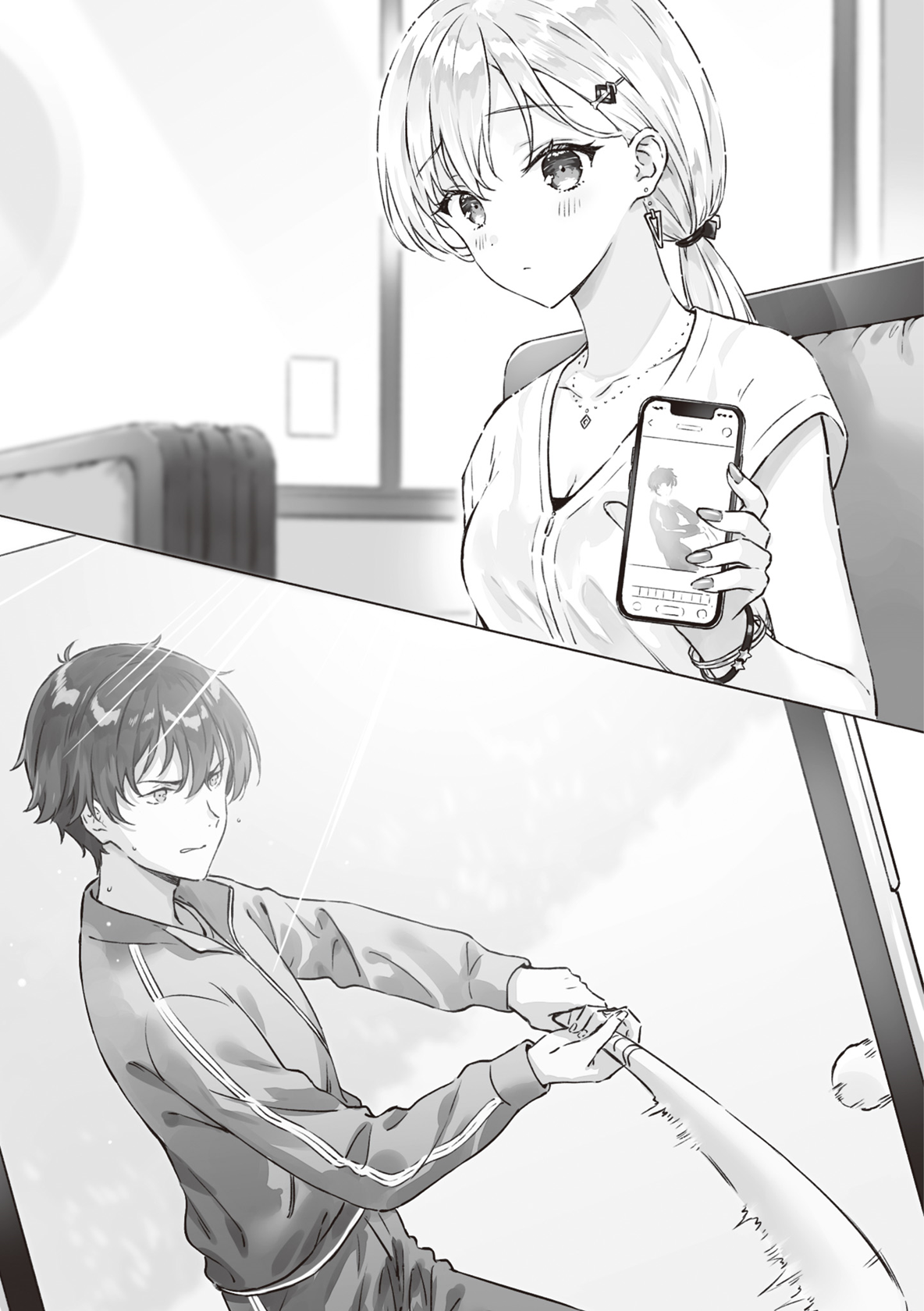
On her phone was a perfectly captured photo of me mid-swing. Unlike Narasaka-san’s video, her photo was zoomed in, focusing only on me. The angle, the timing, the lighting—it was a beautiful picture, though it felt embarrassing to describe it that way when the subject was myself.
“Don’t tell me you’re going to post it on Instagram…”
“I won’t. If you think I’d do something like that, I’m offended.”
“Right. I know, but just in case.” I felt relieved, but also a faint sense of disappointment. My empty Instagram versus her fulfilling one. If I could exist as a character in her world through her posts, I suddenly thought I’d be happy with that.
But then again, having my face broadcast to the world as her boyfriend felt like a bit much. My stepmom, Akiko-kaasan, would definitely see it.
After we finished looking back on the game, Narasaka-san suddenly asked with a smile, “So, Asamura-kun. How was baseball?”
My eyes met Maru’s. His held a hint of concern.
“It was fun,” I answered. A look of relief washed over his face.
It wasn’t a lie. I was exhausted, but it had been a genuinely fun time. I decided I would join them again if my schedule allowed.
On the way home, walking with Saki, I looked back on the day.
“It looked fun,” she said. “Hey, let’s play catch, just the two of us, next time.”
“Then we’ll have to buy a glove for you too, Saki.”
“Yeah. But really, that last one was so close.”
“Honestly,” I said half-jokingly, “the moment it hit, I thought it might be a home run.”
“Me too! It just flew up, like it was being sucked into the blue sky. I actually shouted ‘It’s gone!’ at that moment.”
“You did? Aw, I missed it.”
“Why are you disappointed?” she said, pouting her lips in embarrassment.
Truthfully, while I was in the batter’s box, all sounds had felt distant. I hadn’t heard her cheering or anyone else. I was surprised at how much I could concentrate. With my turn at bat coming so often, I didn’t have time to dwell on failure; I could only focus on not repeating the same mistakes.
Maybe that was a good thing.
“A hundred thoughts are no match for a single action.”
For some reason, the words of the driving instructor came back to me.
University went on summer break. Around the same time, I finished my driving lessons, passed the graduation test, and received my certificate. All that was left was to go to the driver’s license center for the final written exam.
After a forty-minute train ride to the testing center near Shinagawa, I passed the exam and finally had my license in hand. The whole process took half a day, but I had managed to get it on schedule. I felt relieved, but also a slight sense of loss.
Ah, I’ve run out of things I want to do.
Looking back, I realized there were very few times I had started something on my own initiative. My entrance exams, my choice of high school—all of it had been passive. My first real resolution was probably my part-time job at the bookstore. It was an accumulation of small factors: I liked books, I was familiar with the store, and the cost of buying them was becoming a burden.
It was there that a sharp-witted senpai, Yomiuri-san, made me realize that even the books I thought I was buying casually had a reason behind their purchase. One day, after my shift, I brought a book to the register. Yomiuri-san, who was working, gave me a smirk.
“This book… is there something wrong with it?” I’d asked.
“Not at all. But, Kouhai-kun, did you notice? That book isn’t a new release.”
I checked the publication date and saw it was three years old. It had been placed next to a new book on a related topic.
“I thought that a customer like you, Kouhai-kun, would notice it if I put it there,” she’d said. “Hehehe. Well, I didn’t think you’d actually buy it, though.”
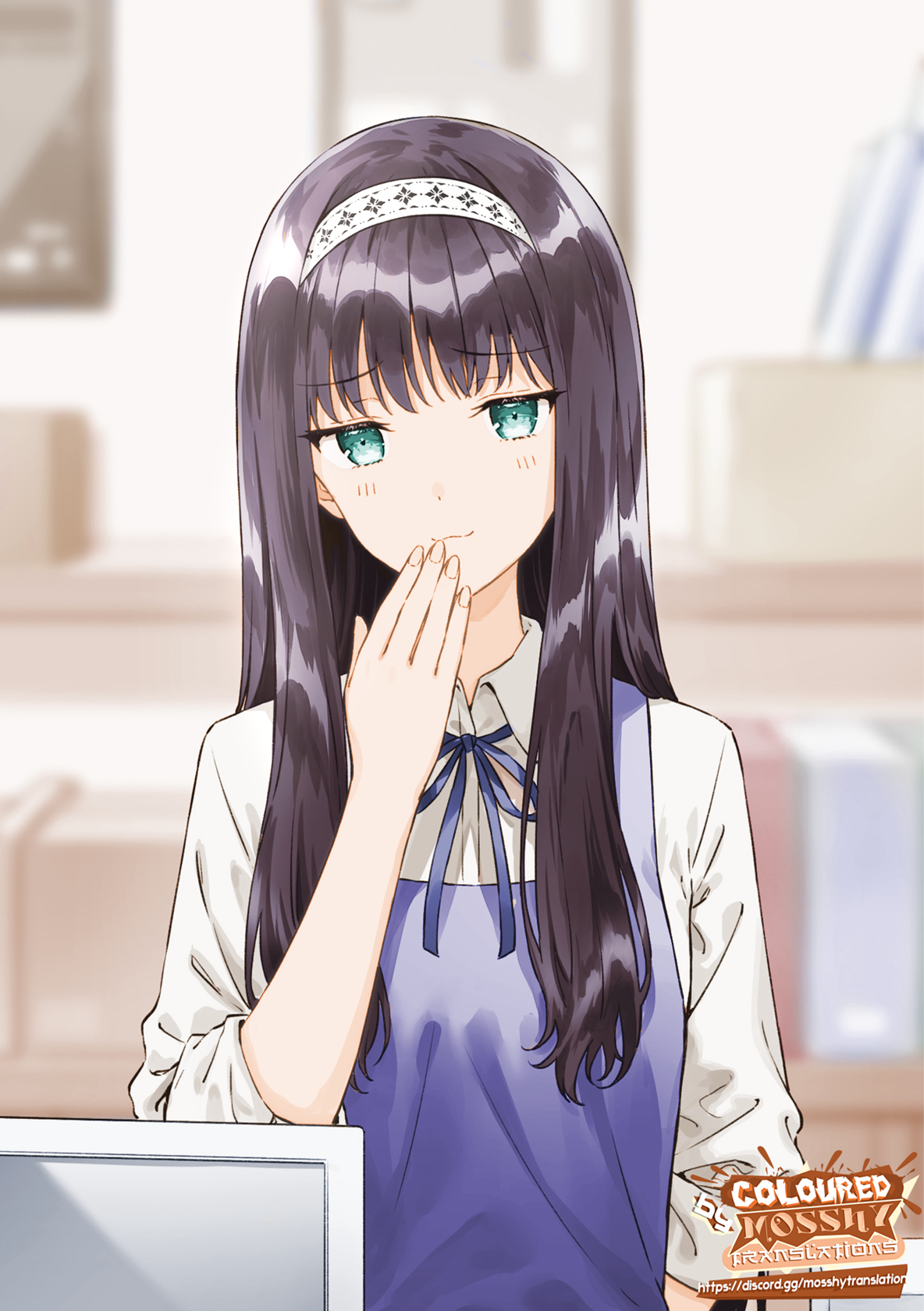
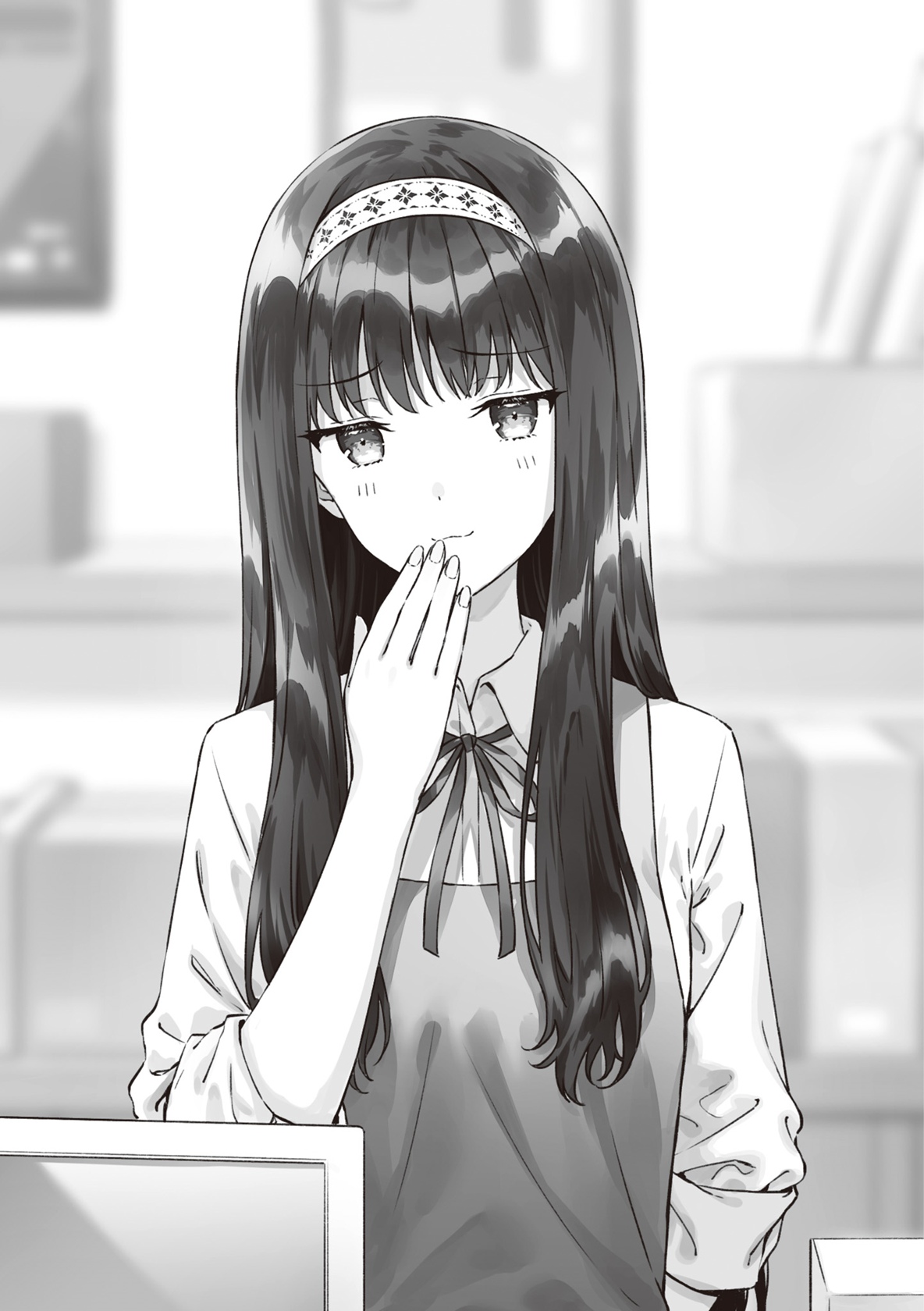
In other words, I had been cleverly guided into buying the book by her subtle recommendation. That experience sparked an interest in what motivates people to act—perhaps because I had such a hard time finding that trigger within myself.
I am, by nature, a person with few things I want to do. I don’t think I need to force myself to create desires I don’t have, but I also want to avoid a situation where I hesitate to reach out and something becomes forever out of my grasp.
Connections with people often roll in unexpected directions. Meeting Professor Mori led me to Ichinose University. Meeting Maru led to a sandlot baseball game. Going to a driving school led me to meet that instructor.
“I think what you’re lacking, Asamura-san, is real experience.”
I was grateful to have been told such things. But my driving lessons were over. The challenge had come to a close. I had my license, but I hadn’t thought about what came next. The goal had been achieved. But what lay beyond it?
Why had I been motivated to get a license in the first place?
It’s because I had a dream, I remembered. A dream that was already fading from my memory. In it, I was trying to go somewhere with Saki and… children.
Ah, that’s right.
The sea.
I wanted to go to the sea.
If I suddenly invite her to the sea during summer break, what will she think? Will she find it strange? It’s thoughts like that, the fear of how others will react, that have always held me back. I can’t predict how others will feel. Even if they’re laughing, they might be annoyed on the inside. That fear is always there.
But…
“Whether they accept you or reject you, all of that comes after you first express your intentions.”
It was the same as merging onto the highway. I’m good at adjusting to my surroundings but bad at making them adjust to me, all because I’m afraid of getting hurt.
I suddenly remembered my conversation with Maru. When I asked him if catching the hardball hurt, he’d said, “It does. It’s fine. You get used to it.”
Ah, I see…
You probably can’t learn to run without falling down at least once.
“Maybe you should value physicality a bit more, Asamura-san.”
Yes. If I just step on the accelerator, if I just merge, maybe I can let myself go with the flow and drive on forever.
I want to go to the sea, with you.
Without being afraid of the first step, I’ll try proposing it to her.